Proof

Authorized Payments: A Modern Scam Story

The article "Authorized Payments: A Modern Scam Story" discusses the rise of authorized payment scams in the U.S., highlighting that current payment authentication methods confirm transaction initiators' identities but fail to detect deception or coercion, leading to significant fraud losses—$12.5 billion in 2024—with regulatory gaps under Regulation E leaving victims unprotected, and emphasizes the need for improved authentication that verifies transaction context beyond mere identity.

New

Proof gives AI agents a way to prove what they're authorized to do

Introducing portable identity
Learn more

Notarize now Log in

Cracking the Identity Code: Authorized Payments (A Modern Scam Story)

Updated August 4, 2026

Fraud, Scams, and Broken Policy - Part 1 of 3

Welcome back to Cracking the Identity Code!

We’ve broken out our next installment, “Fraud, Scams, and Broken Policy,” into a three part series, where we help break down the current state of scams in the U.S. In Part 1, we take a closer look at the growing issue of authorized payment scams and how existing regulations and product design have impacted this trend.

Key Takeaways

  • Payment authentication confirms who is initiating a transaction using factors like a password, a device, or a biometric. It does not confirm whether that person is acting freely or under deception.
  • APP scams exploit a legal gap in U.S. consumer protection: because the victim technically authorized the transfer, banks are generally not required under Regulation E to reimburse the loss.
  • Americans reported $12.5 billion in fraud losses in 2024, a 25% jump from 2023. Imposter scams alone accounted for more than $2.9 billion of that total.
  • Standard authentication controls (passwords, one-time passcodes, device recognition) verify identity at the moment of login. They cannot verify the context behind a transaction or detect social engineering.
  • Closing this gap requires authentication that goes beyond "who is pressing the button" to include defensible, recorded evidence of what was authorized and under what circumstances.

Authorized Payments: A Modern Scam Story

Imagine getting a late-night call and the caller ID comes up as your bank. The person on the line says fraudsters are targeting your account. They know your name and even the last four digits of your account. To “secure” your funds, they urge you to quickly transfer your money into a “safe” holding account – which you promptly do via your banking app. Only later do you realize the truth: the caller was a scammer, and you just authorized a payment straight into their hands. This scenario is not far-fetched; it’s a textbook example of an authorized push payment (APP) scam. Such scams are fueling a surge in fraud losses and exposing gaping holes in consumer protections.

Note on APP Fraud: Understanding APP fraud is important because APP systems are “new” vs. the legacy systems that fraud controls were built around. It’s as simple as thinking about someone handing you money (APP) vs. someone going into your wallet and taking it (account takeover - ATO fraud).

Fraud Losses at Record Highs

Fraud losses in the United States have soared to unprecedented levels in recent years. In 2023, Americans reported losing over $10 billion to fraud – the first time annual losses hit double digits. In 2024 it got even worse, jumping another 25% to $12.5 billion. Imposter scams (like the fake bank caller above) are now a leading fraud category, responsible for over $2.9 billion of 2024’s losses. One especially pernicious subset – scammers impersonating government officials – spiked from $171 million in 2023 to $789 million stolen in 2024.

For businesses and banks, the damage goes beyond the dollars directly stolen. Studies find that every $1 lost to fraud actually costs about $3.75 after accounting for recovery efforts, investigations, and reputational damage. In short, today’s fraud isn’t just hackers infiltrating systems; it’s con artists infiltrating minds. And it’s revealing a serious mismatch between how our financial system defines an “unauthorized” transaction and the reality of how modern scams operate.

When “Authorized” Means No Protection

Why are victims of scams like the one above often left holding the bag? The answer lies in an outdated approach to both regulation and bank policy. Under U.S. law – specifically Regulation E of the Electronic Fund Transfer Act – banks must reimburse customers for “unauthorized” electronic transactions (for example, if a hacker breaks into your account and steals money). But if you initiate the transfer yourself – even if you were tricked or coerced – it’s not legally deemed “unauthorized.” In those cases, banks aren’t required under Reg E to make the consumer whole. In other words, an APP scam where a victim is socially engineered into sending money falls into a gray area not clearly covered by existing consumer protections.

By contrast, credit cards have long touted “zero liability” for fraud, but those guarantees were designed for traditional fraud (like a thief making charges on your stolen card), not for scenarios where you willingly authorize a payment under false pretenses.

For example, if a scammer convinces someone to buy $5,000 in gift cards for a fake IRS agent, the card network’s rules may not automatically cover that loss, since the cardholder technically made the purchase. Similarly, peer-to-peer payment networks like Zelle historically offered little to no protection for these authorized scams. Only recently, amid public and regulatory pressure, have major banks agreed to voluntarily reimburse certain scam victims as a goodwill gesture. These commitments, however, are voluntary, inconsistent, and dependent upon each bank’s approach to balancing consumer protection, creating disincentives for fraudsters, and managing shareholder expectations – resulting in a patchwork rather than a guarantee. One bank might refund a Zelle imposter scam, while another denies a similar claim, leaving consumers with uneven outcomes.

This has resulted in a clear gap in our dispute systems where we can create incentives for all participants to drive fraud rates down (from scams), while increasing consumer protection. Our fraud liability rules were built for a world where criminals impersonate you to your bank, not where they impersonate your bank (or another trusted authority) to you. Victims who are deceived into authorizing payments often find there’s no clear safety net. U.S. regulators like the CFPB have hinted at closing this gap, and lawmakers have raised alarms, but so far the liability for scams still largely falls on the victim rather than the institution. This is a blind spot in consumer protection: when a transaction is technically “authorized” by the user, everyone treats it as legitimate – even if that authorization was obtained by fraud.

Frictionless Payments, Needless Risk

Modern banking and payment apps are designed to be frictionless – assuming that if the logged-in, authenticated user initiates a transfer, it must be legitimate. Traditional fraud controls focus on preventing unauthorized access: strong passwords, device recognition, OTP codes, biometric login, etc. But those measures do little when the real customer is unwittingly doing the fraudster’s bidding. In an APP scam, all the bank’s security checkpoints light up green (correct password, verified device, confirmed text code), so the transaction sails through. The system has no insight into the customer’s state of mind. As fraud experts lament, today’s controls can verify who is making the payment, but not why – they can’t tell if you’re making that transfer under duress or deception.

This design gap means many banking apps will dutifully execute even highly unusual payments with only minimal warnings. A victim can often push through a large wire or a series of transfers to a brand-new payee with just a cursory “Are you sure?” prompt. By the time the customer or bank realizes something is wrong, the money is long gone. Contrast this with the United Kingdom, where rising losses from these scams forced a re-think. UK banks introduced a Confirmation of Payee system to check if the recipient’s name matches the account name, warning customers of mismatches. They also adopted a Contingent Reimbursement Model(CRM) in 2019 – a voluntary industry code to reimburse APP scam victims by default unless gross negligence is shown. In effect, UK banks collectively acknowledged that scam victims shouldn’t automatically bear the loss.

In the U.S., no such broad requirement exists yet. As an ex-banker and someone who loves payments (and as a parent!), one thing I’ve learned is that without clear rules, mayhem will ensue. Banks have begun adding extra warnings or callback verifications for risky transactions, and some are reimbursing scams on a case-by-case basis, but there is no universal standard. The idea of forcing banks to pay for customer-authorized scams remains hotly debated. And not many are empathetic to banks, but the reality is that without clear rules, they are destined to disappoint. Banks worry it could encourage fraud with no-recourse or complacency by the consumer, while consumer advocates point to the UK’s example as a path to better protection (but that comparison doesn't account for the fundamental differences in how each jurisdiction approaches regulations).

For now, American consumers face an uneasy truth: if you are conned into authorizing a fraudulent payment, the default assumption is that it’s on you. The system’s protections haven’t caught up to the tactics that scammers are now using, leaving a critical policy and design gap where trust can be exploited.

Bottom line: Today’s fraud landscape has shifted under our feet. The biggest threats are no longer someone stealing your credentials without your knowledge – it’s someone stealing your confidence and consent. Yet our rules and app designs haven’t fully adapted. This gap between old definitions of “unauthorized” and new forms of authorized scams is exactly what criminals are exploiting, and it’s why so many victims (like the unfortunate caller in our story) find themselves with no recourse after the fact.

In the next installment in this series, we'll take a closer look at modern fraud threats, from impersonation to first-party fraud. We'll explore what this changing landscape means for banks and why securing account access is just one part of the solution, and why banks need to think more strategically about the context behind every transaction.

graphic of envelop on a square

Subscribe to our newsletter

Sign up

Related Articles

\ \ Fraud\ \ Anatomy of a Fraud Attempt: Five Tries, Each Deepfake Better Than the Last\ \ A $74,000 cash-out came back five times, from a different country each time, the deepfake improving on every attempt. The pattern was the detection.\ \ \ \ Proof\ \ October 26, 2026

\ \ Fraud\ \ Anatomy of a Fraud Attempt: The Signer Who Changed Computers Mid-Session\ \ A signer joined a $195,000 transaction on a laptop and finished on a different desktop with high-end graphics. How a deepfake attempt actually runs.\ \ \ \ Proof\ \ October 23, 2026

\ \ Financial Services\ \ The Exception Desk: Beneficiary Changes | October 2026\ \ Forged beneficiary changes go unnoticed for years. Discover why current workflows fail identity checks and how Proof secures the process against fraud.\ \ \ \ Jay Bletzer\ \ October 22, 2026

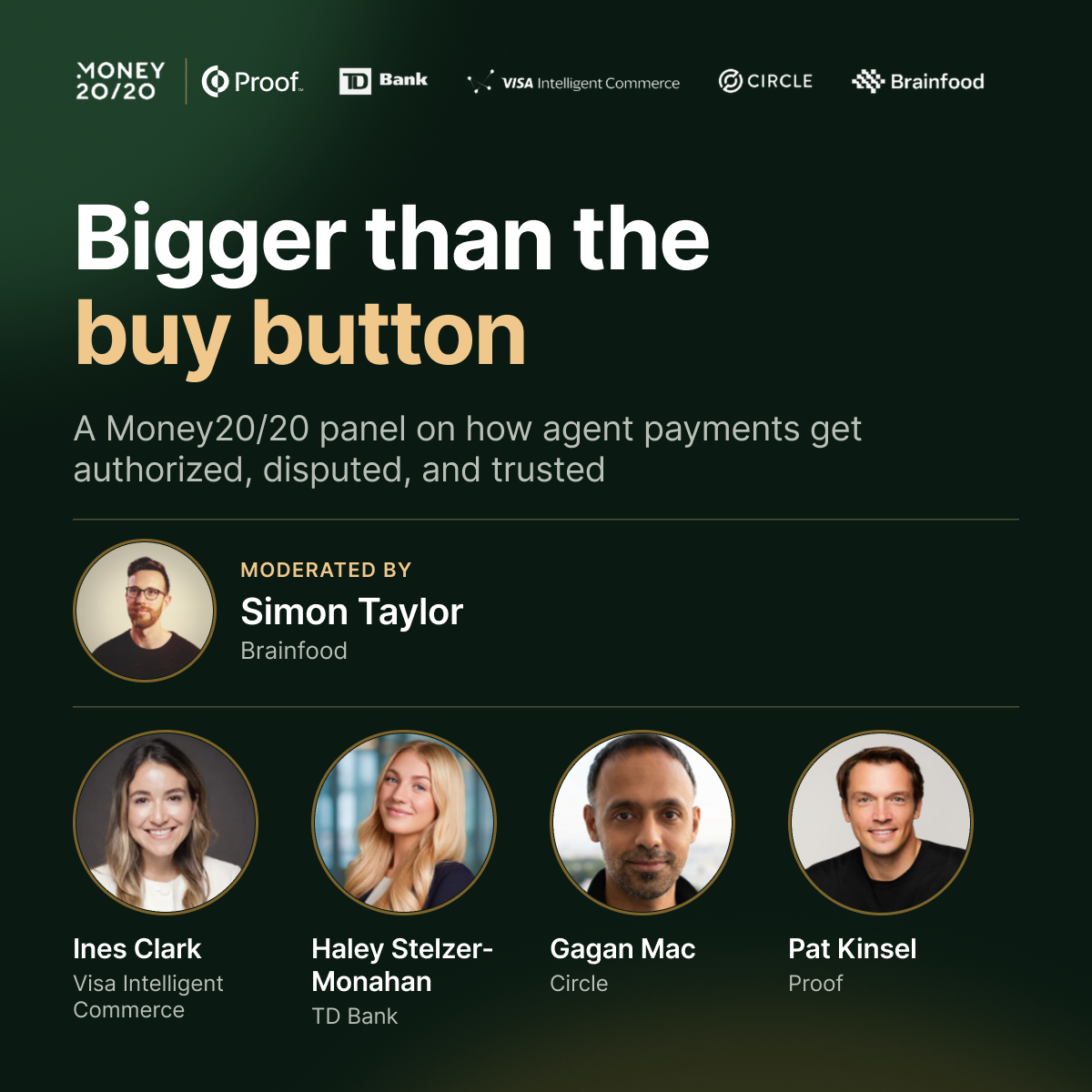
\ \ Product & News\ \ Agentic commerce is here. The proof of authority is missing.\ \ Simon Taylor of Brainfood brought together leaders from Visa Intelligent Commerce, Circle, TD Bank, and Proof to discuss how agent payments get authorized and trusted by banks at Money20/20.\ \ \ \ Proof\ \ October 21, 2026

\ \ Product & News\ \ x401 Protocol Created by Proof Now Offers Simple Cloudflare Integration, So Cloudflare Workers Can Verify the Human Behind the Agent\ \ Built on HTTP’s familiar 401 and the OpenID for Verifiable Presentations standard, x401 is live in production and now works with Cloudflare Workers. \ \ \ \ Proof\ \ October 20, 2026

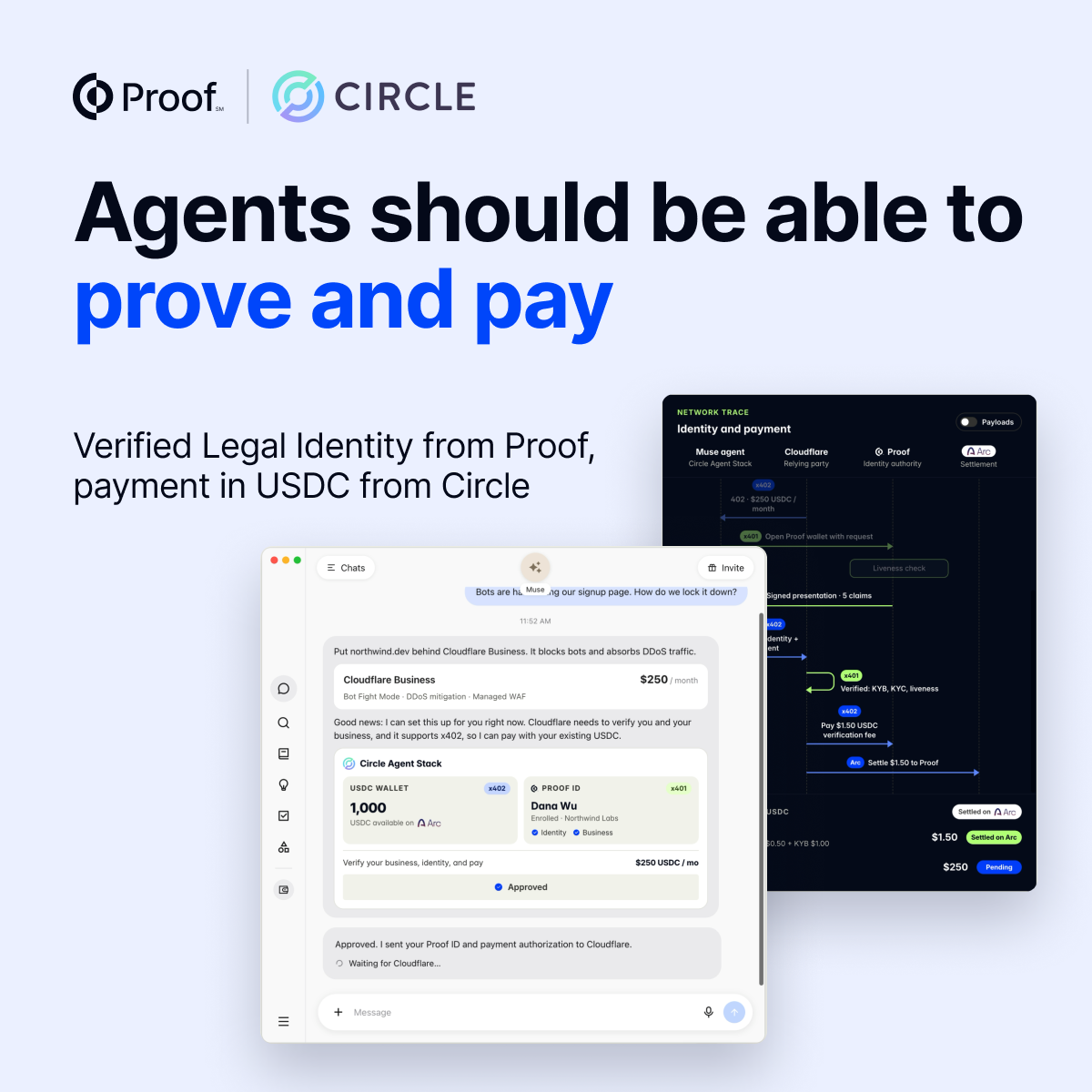
\ \ Product & News\ \ Proof and Circle Show How AI Agents Can Prove Who They Act For and Pay in USDC\ \ Proof and Circle Internet Group today announced a collaboration showing how verified legal identity and machine-native payments can work together in agent transactions. At Money20/20, teams from the companies will demonstrate a demo of an AI agent completing an identity-gated purchase where the agent presents a verified Proof credential using x401, Proof's open identity protocol, and pays the merchant in USDC over x402 using a Circle Agent Wallet.\ \ \ \ Proof\ \ October 19, 2026

\ \ Product & News\ \ Proof Launches x401, Giving AI Agents A Way to Prove Who They Represent - and What They're Authorized To Do\ \ Proof’s agent identity wallet and the open x401 protocol bring verified legal identity and signed transaction authorization to AI agents, with support for Meta’s Muse, ChatGPT, Grok and Claude, and pay-per-use verification\ \ \ \ Proof\ \ October 15, 2026

\ \ Fraud\ \ The Fraud Files: When Fraud Went Corporate | October 2026\ \ Agentic AI is expected to cut the cost of running a fraud operation by 90% within two years, according to BCG's June 2026 analysis, triggering a twofold surge in volume at minimum. In the same period, Fraud-as-a-Service platforms gave criminal networks subscription tiers, customer support channels, and the ability to rent SIM cards across 80 countries. Fraud got cheaper this month.\ \ \ \ Ray Hayes\ \ October 14, 2026

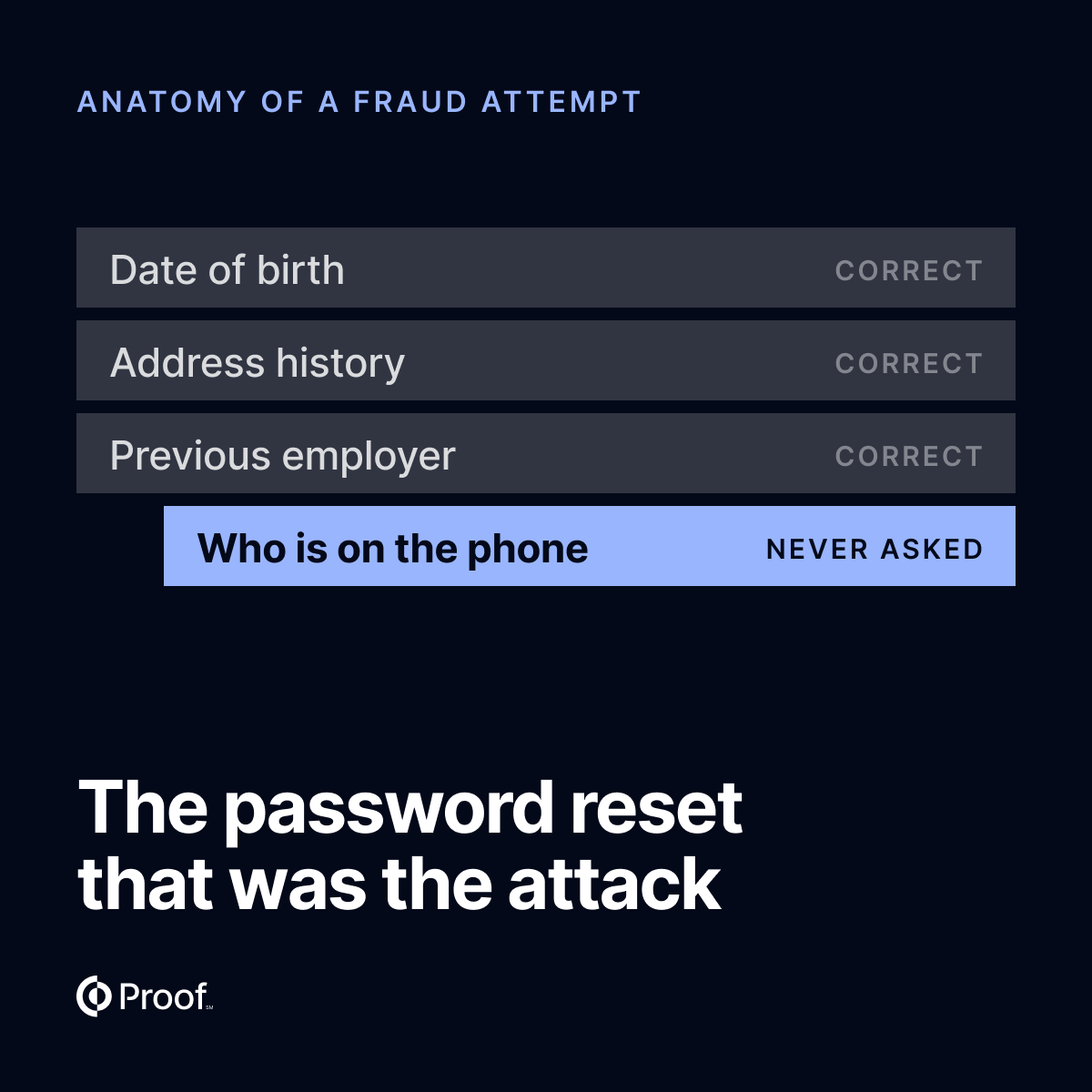
\ \ Fraud\ \ Anatomy of a Fraud Attempt: The Password Reset That Was the Attack\ \ No breach, no malware, no stolen password. The attacker used the account recovery flow exactly as designed. How the scheme runs and what stops it.\ \ \ \ Proof\ \ October 12, 2026

\ \ Fraud\ \ How Businesses Reduce Help Desk Social Engineering Attacks\ \ The help desk approves sensitive actions using evidence that was never strong enough to carry them. Replacing that evidence is the fix.\ \ \ \ Proof\ \ October 8, 2026

\ \ Hiring & Onboarding\ \ Candidate Fraud and the Continuity Gap in Remote Hiring\ \ Remote hiring kept every interview round and quietly dropped the handoff between them. We joined Recruiting Future Ep 825 to talk through what to do about it.\ \ \ \ Jessica Howe\ \ October 7, 2026

\ \ Product & News\ \ Proof Appoints Jeremiah Glodoveza as Chief Marketing Officer\ \ Award-winning payments and identity marketing leader joins to scale Proof's identity authorization network as AI agents reshape digital trust\ \ \ \ Proof\ \ October 6, 2026

\ \ Fraud\ \ An AI Just Passed the Video Turing Test. Who's on Your Next Call?\ \ Tavus says its AI fooled 48% of people on live video calls. Here's what that means for hiring and fraud teams.\ \ \ \ Proof\ \ October 5, 2026

\ \ Digital Identity\ \ What Makes ID Checks Fail\ \ Some failures turn away real people. The expensive ones return a clean pass on a transaction that should never have completed.\ \ \ \ Proof\ \ October 5, 2026

\ \ Fraud\ \ Anatomy of a Fraud Attempt: the Photograph of a Building Nobody Owned\ \ The building was real. The photos were real. The person renting it out owned none of it. How listing fraud runs, and the check that actually stops it.\ \ \ \ Proof\ \ October 4, 2026

\ \ Fraud\ \ Can AI Deepfakes Bypass Identity Verification?\ \ Yes. The working attacks replace the camera feed rather than fooling the camera, and most platforms stop watching before the transaction happens.\ \ \ \ Proof\ \ October 2, 2026

\ \ Fraud\ \ How Companies Prevent Account Takeover Fraud\ \ MFA closes the front door. Account recovery exists to open it again, and that is where the money goes.\ \ \ \ Proof\ \ October 1, 2026

\ \ Digital Identity\ \ How to Verify the Identity of an AI Agent\ \ An agent can complete the application perfectly and still get refused. What is missing is evidence that a verified person authorized it.\ \ \ \ Proof\ \ September 30, 2026

\ \ Hiring & Onboarding\ \ Face Rental: The Candidate Fraud That Passes Every Document Check\ \ A real person with a real government ID sits the interview while someone else does the work. Document checks, face match and liveness all pass. Here is what catches it.\ \ \ \ Kurt Ernst\ \ September 28, 2026

\ \ Real Estate\ \ The Seller Who Isn't in the Room: What Remote Closings Actually Fix in Title and Escrow\ \ The buyer was ready, the file was clean, the date was set. One person needed to sign in front of a notary, and that person was going to be somewhere in the middle of a sea for the next eight weeks. Without a remote option, a closing that is otherwise finished waits until he gets back. Every title company has a version of this seller.\ \ \ \ Kavya Qin\ \ September 25, 2026

\ \ Financial Services\ \ The Exception Desk: Wire Callbacks | September 2026\ \ The Exception Desk is a monthly look at one exception process banks still run by hand — what it is, how it actually gets handled today, and what it would take to make it digital. First up: the wire callback.\ \ \ \ Jay Bletzer\ \ September 24, 2026

\ \ Hiring & Onboarding\ \ Why Fake Candidates Stopped Standing Out in Your Pipeline\ \ AI agents flooded your funnel with real applicants, which is exactly what gives fabricated ones somewhere to hide. Here is where the check has to move to.\ \ \ \ Lauren Furey\ \ September 23, 2026

\ \ Product & News\ \ Proof and Superfluid: A Verified Human Behind Every Agent Transaction\ \ Today Proof announces a partnership with Superfluid Finance in their launch of Superfluid Wallet, a wallet that a person and their AI agents use together. Proof provides the human identity layer of the wallet through verifiable credentials for both individuals and businesses.\ \ \ \ Proof\ \ September 22, 2026

\ \ Fraud\ \ The Fraud Files: When the Verification Layer Became the Target | September 2026\ \ Three years ago, deepfake fraud accounted for 0.1% of global fraud attempts. Today that figure is 6.5%, a 65-fold rise driven by injection attacks up 40% year over year and $410 million in first-half losses alone. The verification layer is the target now.\ \ \ \ Ray Hayes\ \ September 21, 2026

\ \ Financial Services\ \ The Last Mile That…Wasn't: Notarization Challenges in Lending and Equipment Finance\ \ Lending got fast. Then the Power of Attorney needs a notary…and the deal sits. Let’s talk about what happens when lending and financing workflows go fully digital, including notarization.\ \ \ \ Adam Fekini\ \ September 18, 2026

\ \ Fraud\ \ Why The Right Fraud Tools Can Help Stop Seller Impersonation\ \ ALTA found seller impersonation attempts more than doubled in a year, even as title firms added detection tools.\ \ \ \ Proof\ \ September 16, 2026

\ \ Workflow\ \ Remote Online Notarization: The Last Analog Step in Digital Transformation\ \ Digital transformation isn’t complete until the experience is seamless for your customer. See how Proof helps bring remote online notarization (the last analog step) online for organizations across industries.\ \ \ \ Proof\ \ September 16, 2026

\ \ Product & News\ \ Proof Launches Portable Digital Identity for Banks as Federal Regulators Recognize Verifiable Credentials Under CIP Rules\ \ Days after FinCEN and federal banking agencies updated customer-identification guidance to expressly include verifiable digital credentials, Proof launches a reusable digital identity backed by IAL2 identity proofing and its WebTrust-audited certificate authority.\ \ \ \ Proof\ \ September 15, 2026

\ \ Fraud\ \ What is a Fraud Signal?\ \ A fraud signal is one piece of evidence about a transaction. Here is what the common signals measure and how they combine into a decision your team uses.\ \ \ \ Kurt Ernst\ \ September 14, 2026

\ \ Real Estate\ \ What Is MISMO Certification, and Why Do Mortgage Lenders Care Which RON Platform Has It?\ \ A lender closes a loan using one RON platform. Months later, that loan is sold to an investor whose due diligence team wants to confirm the notarization holds up to scrutiny. That's the exact problem MISMO's RON Certification exists to solve, and it's why "is this platform MISMO certified" is one of the first questions serious mortgage professionals ask before choosing a RON vendor. \ \ \ \ Jessica Howe\ \ September 10, 2026

\ \ Fraud\ \ The Sellers Never Showed Up. The Houses Sold Anyway.\ \ Two San Diego homes sold by people who never owned them and never met a buyer. Inside seller impersonation fraud.\ \ \ \ Proof\ \ September 9, 2026

\ \ Technology\ \ Mobile Notary, Online Notary, or Traditional Notary: When Should You Use Which?\ \ Mobile, online, and traditional notaries each solve a real problem, just not the same one, and the wrong choice usually costs you either time or money you didn't need to spend. Here's how to tell which situation you're actually in.\ \ \ \ Proof\ \ September 8, 2026

\ \ Fraud\ \ What Businesses Need to Know About ID Scans and Retention Risk\ \ A dark web service sold scans of 153 million driver's licenses. Verifying identity should not mean storing the document.\ \ \ \ Proof\ \ September 3, 2026

\ \ Financial Services\ \ Six Money-Out Moments Worth Auditing in Your Firm\ \ Withdrawals, beneficiary changes, spousal consent, wires, account recovery, POAs. Audit the identity evidence your firm holds at each money-out moment.\ \ \ \ Ray Hayes\ \ September 3, 2026

\ \ Hiring & Onboarding\ \ What Deepfake Detection Actually Analyzes in a Candidate Video\ \ The question HR leaders ask most often after seeing deepfake detection in action: "But how does it actually know?" Most vendors respond with an accuracy rate, and that matters. But a rate tells you how a model performed against known attacks. What happens when attack techniques evolve?\ \ \ \ Kurt Ernst\ \ September 2, 2026

\ \ Product & News\ \ See Your Fraud Data, Keep Your Transaction History, and Close with Confidence. What’s new in August.\ \ This August, we're shipping updates across fraud detection, closing workflows, and transaction management. Defend gains automatic blocking of known bad actors, a configurable risk routing engine, and on-demand portfolio visibility into fraud performance. \ \ \ \ Proof\ \ September 1, 2026

\ \ Financial Services\ \ How Equipment Finance Companies Close Loans Remotely\ \ How lenders replace manual POA notarization with remote online notarization, closing in days instead of weeks, plus the identity gap at equipment pickup.\ \ \ \ Adam Fekini\ \ September 1, 2026

\ \ Digital Identity\ \ Authentication Verifies What You Have, Not Who You Are\ \ Authentication confirms you have the right credential. Cryptographic identity confirms you are who you say you are. Learn why the gap between those two questions is where enterprise breaches happen, and what closes it.\ \ \ \ Kris Singh\ \ August 28, 2026

\ \ Digital Identity\ \ Sanctions screening is live. Your KYB record isn't.\ \ Banks screen payments in real time but trust business identity in retrospect. Why point-in-time KYB leaves a gap that fraud is built to use.\ \ \ \ Kris Singh\ \ August 27, 2026

\ \ Digital Identity\ \ What Actually Happens During a Video Identity Verification Session with Proof\ \ What happens in a live video identity session with Proof: when it triggers, what runs during the call, who supervises it, and what you hold afterward.\ \ \ \ Lauren Hintz\ \ August 26, 2026

\ \ Hiring & Onboarding\ \ How to Catch Candidate Fraud Without Changing Your Greenhouse Workflow\ \ Identity verification has a reputation for slowing hiring teams down. A link goes to the candidate, a review queue opens somewhere, and your recruiters are waiting on a third system before anyone can move forward. That is not how Proof works inside Greenhouse.\ \ \ \ Eric Nelson\ \ August 25, 2026

\ \ Fraud\ \ 72 Fake Sites, One Phone Call: Vishing Hits Private Equity\ \ Hackers called employees at some of the largest private equity firms. The MFA codes were typed into 72 spoofed sites.\ \ \ \ Proof\ \ August 24, 2026

\ \ Digital Identity\ \ The Messy Identity Verification Stack Behind Most Online Gaming Platforms\ \ Gaming platforms layer six identity verification methods, from KYC to liveness detection. Learn what each proves, and where the stack leaves value exposed.\ \ \ \ Jessica Howe\ \ August 24, 2026

\ \ Digital Identity\ \ Why Identity-Verified Signing Matters, and How to Evaluate It\ \ Real estate fraud losses jumped 58% to $275 million in 2025, and most e-signature software still can't tell you whether the person who clicked "sign" is who they claim to be.\ \ \ \ Proof\ \ August 21, 2026

\ \ Auto\ \ The Three Identity Checks in an Auto Deal, and Why the Last One Breaks\ \ An auto deal verifies identity three times: credit application, signing, and title work. Let’s look at what each check proves, and why the last one stalls funding.\ \ \ \ Jay Bletzer\ \ August 20, 2026

\ \ Fraud\ \ The Fraud Files: When Trust Became the Attack Surface | August 2026\ \ Three separate findings from the first week of August 2026 arrived at the same structural conclusion from different directions. Attackers are moving away from defeating security controls and toward inheriting the trust those controls extend, and the identity layer is where the convergence is most visible.\ \ \ \ Ray Hayes\ \ August 19, 2026

\ \ Technology\ \ Electronic Signatures and Digital Signatures: The Difference and Why It Matters\ \ "Digital signature standard" gets used to describe cryptography, US law, and EU law almost interchangeably, and only one of those things determines whether the signature underneath can actually be forged.\ \ \ \ Gary Weingarden\ \ August 18, 2026

\ \ Fraud\ \ 1,000 Companies in 3 Months: North Korea's Hiring Infiltration\ \ A WSJ investigation traced North Korean operatives into US jobs. The gap they exploited is hiring identity.\ \ \ \ Proof\ \ August 17, 2026

\ \ Real Estate\ \ How to Evaluate eClosing Platforms\ \ A platform's fastest closing time is meaningless if it can't legally close a loan in the state where your borrower lives, so evaluate eligibility and integration before you look at the interface.\ \ \ \ Kavya Qin\ \ August 14, 2026

\ \ Fraud\ \ Inside the Fake-ID Detection Stack\ \ Modern identity verification stops fake IDs with five layered checks that each catch a kind of fraud the others miss, from image capture to behavioral risk scoring.\ \ \ \ Jessica Howe\ \ August 13, 2026

\ \ Technology\ \ How to Evaluate an Online Notary\ \ Legal authorization to perform remote online notarization is now nearly universal, so the real question isn't whether a platform is legal, it's whether its identity checks, session record, and notary training can survive a dispute years later.\ \ \ \ Phil Motto\ \ August 12, 2026

\ \ Hiring & Onboarding\ \ The Attack That Breaks the Identity Check You Just Deployed\ \ A lot of hiring teams have spent the past year adding liveness detection to their identity verification process. What this improvement cannot stop, however, is a biometric injection attack.\ \ \ \ Lauren Furey\ \ August 11, 2026

\ \ Digital Identity\ \ The 3 Checks That Catch Most Fake IDs Online\ \ Three checks, run together, stop the vast majority of fake IDs before they turn into a fraudulent account, a bad loan, or a forged signature on a closing document.\ \ \ \ Courtney Leary\ \ August 10, 2026

\ \ Workflow\ \ Which Digital Signature Standard Is Actually Secure?\ \ Ask which digital signature standard is "secure" and most people answer with a law: ESIGN, eIDAS, UETA. The layer that actually decides whether a signature can be forged is cryptographic, and it's called public key infrastructure, or PKI.\ \ \ \ Lauren Hintz\ \ August 7, 2026

\ \ Digital Identity\ \ The One E-Signature Feature That Actually Verifies Identity\ \ Real estate fraud losses hit $275 million in 2025, up 58% in a single year, and the feature that separates a defensible e-signature from a liability is whether the platform actually verifies who is signing.\ \ \ \ Anna Scionti\ \ August 6, 2026

\ \ Real Estate\ \ Is There a Best eClosing Platform? Here's the Short Answer\ \ The best eClosing platform is whichever one is legally eligible everywhere you close and already wired into the systems you run, with demo polish mattering only after both of those checks pass.\ \ \ \ Emily Robbins\ \ August 5, 2026

\ \ Technology\ \ What Makes a Good Online Notary? 3 Things That Actually Matter\ \ Remote online notarization is now legally authorized in nearly every state, but the law only sets a floor. Here are the three things that decide whether a notarization actually holds up.\ \ \ \ Jessica Howe\ \ August 4, 2026

\ \ Product & News\ \ More Ways to Verify, Authorize, and Protect. July Is Here.\ \ This July, we're shipping updates that expand Proof's identity verification capabilities across more workflows and platforms. New features include verifiable credential presentations via API, a drop-in SDK for web, and Okta IDV certification, giving organizations more ways to verify identity where it matters most.\ \ \ \ Proof\ \ July 29, 2026

\ \ Fraud\ \ Fake IDs, Fake Deeds, and $1.5M in Stolen Land\ \ Fraudsters forged deeds and fake IDs to steal a Concord landowner's property. Here's how verifiable identity stops it.\ \ \ \ Proof\ \ July 28, 2026

\ \ Digital Identity\ \ Who's Really Behind That Business? Why KYB Alone Can't Stop Invoice Fraud\ \ we sat down with Enigma last week to dig into a question that sounds almost philosophical until you've lost money to it: who is really behind that business?\ \ \ \ Abbie Kaiser\ \ July 27, 2026

\ \ Digital Identity\ \ Your Account Recovery Process Is Your Biggest Security Gap\ \ Stop relying on help desk judgment for account recovery. Learn how identity-first verification closes your biggest security gap and prevents vishing attacks.\ \ \ \ Kris Singh\ \ July 24, 2026

\ \ Technology\ \ The Authorization Gap: Why Agentic Commerce Can't Scale Without an Identity Layer\ \ Every major agentic commerce protocol has built serious infrastructure for how authorization records should flow. What none of them has defined is who issues the credentials that make those records trustworthy. We partnered with Liminal to research why this gap exists, why it can't close on its own, and what filling it actually requires.\ \ \ \ Jessica Howe\ \ July 23, 2026

\ \ Hiring & Onboarding\ \ What Identity Verification Actually Looks Like for Your Real Candidates\ \ Every conversation about candidate fraud eventually runs into the same concern: we can't add friction for candidates. The hiring market is competitive. Candidates drop off. A bad experience reflects on the employer brand, and the last thing a talent team needs is another step in the funnel that loses real people before they ever get to an interview.\ \ \ \ Leandra Fishman\ \ July 22, 2026

\ \ Financial Services\ \ The Real Cost of a Manual POA Process at Your Credit Union\ \ Power of attorney documents show up at some of the most consequential moments in a member's life. And yet, for most credit unions, the POA process is still built around paper. If that friction is costing you member trust, it is also costing you something else: time, money, and competitive ground.\ \ \ \ Jessica Howe\ \ July 20, 2026

\ \ Legal\ \ A Historic Step Toward the American Dream\ \ On July 10th, the 21st Century ROAD to Housing Act became law, marking the most significant bipartisan housing reform in decades. ROAD stands for Renewing Opportunity in the American Dream, and that is what the law sets out to do: expand access to homeownership for more Americans.\ \ \ \ James Fulgenzi\ \ July 17, 2026

\ \ Hiring & Onboarding\ \ This Is What Candidate Fraud Looks Like From the Inside\ \ Do you know how candidate fraud scams actually get built? Last week, a member of Proof's team received an email that answers that question directly.\ \ \ \ Lauren Ding\ \ July 15, 2026

\ \ Fraud\ \ The Fraud Files: Agents, Impersonation, and the Identity Layer Nobody Built | July 2026\ \ AI agents are transacting on behalf of real people, on real payment rails, right now. The fraud ecosystem built around that fact is already operational, and this month's headlines show exactly how the attack surface is forming.\ \ \ \ Ray Hayes\ \ July 13, 2026

\ \ Digital Identity\ \ What Is Digital Identity? A Complete Guide\ \ Digital identity is a persistent, cryptographically secured credential that represents a verified person. Once established, it does not expire with a session or reset between transactions. It travels with the user across interactions, and it gets stronger and more useful with every use.\ \ \ \ Anna Scionti\ \ July 10, 2026

\ \ Hiring & Onboarding\ \ The Return to In-Person Interviews Is an Admission, Not a Strategy\ \ What companies bringing interviews back in person have concluded is that they cannot verify who is sitting on the other end of a video call with enough confidence to make the hire. However, the remote-first format alone wasn’t the issue. What was missing underneath it was an identity layer reliable enough to make remote interviews trustworthy.\ \ \ \ Lauren Furey\ \ July 8, 2026

\ \ Auto\ \ Why Auto Lenders Can't Afford to Keep Mailing POAs\ \ Every auto refinance starts the same way: the borrower agrees to the new terms, the deal is approved, and then someone has to get a power of attorney signed so the lender can handle the title transfer without the borrower standing at the DMV counter in person. The lenders who are fixing this are funding faster, cutting operational costs, and closing a fraud vulnerability that paper processes leave wide open.\ \ \ \ Emmy Leitzell\ \ July 6, 2026

\ \ Hiring & Onboarding\ \ When You Find One Fraudulent Hire, You Usually Find More\ \ If one bad actor is successfully hired, they can act as a reference for others, using their insider knowledge of the employer's hiring process to coach additional fraudulent candidates through. That changes the threat model significantly. A single fraudulent hire inside a large remote workforce represents a vulnerability that has already been exploited to map the organization's defenses, and that map is being shared.\ \ \ \ Trisha Sood\ \ July 1, 2026

\ \ Product & News\ \ The Identity Infrastructure for the Internet\ \ The internet needs an identity layer that cryptographically proves who you are, what you've done, and which agents are operating in your name. To solve these challenges, we're releasing x401, an open, issuer-neutral protocol for the identity and authorization challenges created by agents, along with Proof digital ID, the first live implementation on x401, to bring a verified human identity and authorization to every agent action.\ \ \ \ Pat Kinsel\ \ June 29, 2026

\ \ Digital Identity\ \ The Five Levels of Verified Identity For the Agent Economy\ \ AI agents are moving money, but who verifies them? Explore the 5 levels of identity infrastructure required to make the agent economy safe and scalable.\ \ \ \ Darren Louie\ \ June 26, 2026

\ \ Product & News\ \ Introducing x401: Bringing Proof of Identity to the Web\ \ HTTP got a payment status code in 1997. It never got an identity one. We're fixing that. And, with AI agents acting on our behalf now, it matters more than ever.\ \ \ \ Daniel Buchner\ \ June 25, 2026

\ \ Product & News\ \ Proof Launches x401, the Open Protocol for Verifying the Authority Behind AI Agents\ \ Developed by Proof with contributors across payments, identity and AI, x401 lets any online service request proof of who authorized an agent’s actions. Live demos and a CLI are available today.\ \ \ \ Proof\ \ June 25, 2026

\ \ Digital Identity\ \ Why You Can’t Get Pokémon Center Drops (Hint: It’s Not Just Site Issues)\ \ On June 10, 2026, Pokémon Center opened preorders for the Mega Evolution: Pitch Black expansion and, within minutes, the site was down. For retailers and publishers managing high-demand, limited-inventory drops, identity verification at the point of queue entry is the mechanism that makes the difference between a queue full of real customers and a queue full of software.\ \ \ \ Mark Loiselle\ \ June 24, 2026

\ \ Fraud\ \ The Fraud Files: Stolen Credentials, Fake Biometrics, and the Synthetic Identity Wave | June 2026\ \ The way financial institutions verify identity was built around three assumptions: that some information stays secret, that documents can be trusted, and that a face in a camera is a real face. June's research shows each of those assumptions under sustained, commercial-scale attack, with numbers to prove it.\ \ \ \ Ray Hayes\ \ June 23, 2026

\ \ Workflow\ \ Sherpas Healthcare Solutions Wins More Clients with Remote Online Notarization\ \ Sherpas Healthcare Solutions takes the complexity out of chart audit requests for healthcare providers. As demand for notarized affidavits on those records grew, the company ran into a hard limit: they had no way to offer notarization services, and they were losing business to vendors who could. Remote online notarization with Proof gave them a way to say yes.\ \ \ \ Taylor Curtiss\ \ June 18, 2026

\ \ Product & News\ \ Cleaner Data, Tighter Security, and More Admin Control This June\ \ This month's updates are built for Enterprise and Command Center teams that need tighter control over their data and security posture. From deactivating child organizations directly in Command Center to pulling audit events into your SIEM and exporting richer transaction data, June's release gives admins more visibility and more power without requiring a support ticket or a CSM.\ \ \ \ Proof\ \ June 18, 2026

\ \ Technology\ \ Electronic Signatures vs. Digital Signatures: What's the Difference?\ \ The terms get used interchangeably, but they describe fundamentally different things. For most casual use cases, the distinction doesn't matter much. For regulated industries, high-value contracts, or anything that might end up in litigation, it matters a lot.\ \ \ \ Anna Scionti\ \ June 17, 2026

\ \ Hiring & Onboarding\ \ How Generative AI Turned Candidate Fraud Into an Industry\ \ Generative AI has transformed hiring fraud from an individual crime into an industrialized operation, changing the economics so completely that the defenses built for the previous era no longer apply.\ \ \ \ Taylor Curtiss\ \ June 16, 2026

\ \ Workflow\ \ Why Equipment Finance Teams Can't Afford a Manual POA Process\ \ The equipment finance industry is on a growth trajectory. The companies that take POAs digital now are the ones that close deals faster, carry less documentation risk, and build the kind of customer experience that brings lessees back for their next transaction.\ \ \ \ Taylor Curtiss\ \ June 15, 2026

\ \ Digital Identity\ \ How to Implement Digital Identity Verification\ \ Digital identity verification has become a baseline requirement for any organization that onboards customers, processes transactions, or manages sensitive documents online. This guide breaks down the core components of a digital identity verification system, the methods available, and what a thoughtful implementation looks like in practice.\ \ \ \ Courtney Leary\ \ June 12, 2026

\ \ Workflow\ \ Is Remote Online Notarization Legal and Available in All States?\ \ Remote online notarization (RON) is legal in 49 states and the District of Columbia as of 2026. California is the only outlier, with its permanent RON statute set to take effect on January 1, 2030. If your business is thinking about digitizing notarization workflows: yes, RON is an option.\ \ \ \ Phil Motto\ \ June 11, 2026

\ \ Hiring & Onboarding\ \ Why Only 31% of CHROs Are Confident They Can Stop Hiring Fraud\ \ While Chief Human Resources Officers (CHROs) agree hiring fraud requires attention, many doubt their organizations are equipped to stop it. This gap highlights a critical issue: awareness has risen, but infrastructure has not. Fraud persists despite organizational recognition.\ \ \ \ Renée Hunter\ \ June 10, 2026

\ \ Fraud\ \ Real Estate Fraud Hit $275M in 2025. The Fix Isn't Better Agent Training.\ \ Real estate fraud hit $275M in 2025, up 58%. AI is making fake IDs fast enough to pass standard verification at closing.\ \ \ \ Proof\ \ June 8, 2026

\ \ Workflow\ \ Proof Puts Itself To The Test For Account Recovery\ \ IT teams live at the intersection of access and urgency. When an employee is locked out, the pressure is to get them back in fast, and the path of least resistance has always been a direct message. For Proof's IT team, the answer was...Proof.\ \ \ \ Felicia Carnell\ \ June 5, 2026

\ \ Hiring & Onboarding\ \ Your Interviewers Can't Catch Deepfakes. That's Not Their Fault.\ \ If you ask most hiring managers whether they could spot a fake candidate in an interview, a significant number will say yes. They will point to their experience, their instincts, their ability to read a candidate's comfort with their own claimed background. That confidence is understandable and, according to the data, largely misplaced.\ \ \ \ Ashley Bird\ \ June 4, 2026

\ \ Real Estate\ \ The Top States for eClosings in 2026\ \ Your market has already made its decision. Peers and competitors are closing digitally, at significant volume, and they are getting faster at it. And the pattern is consistent: once enabling infrastructure is in place and a few early movers commit, adoption accelerates quickly.\ \ \ \ Kavya Qin\ \ June 3, 2026

\ \ Workflow\ \ What is Remote Online Notarization?\ \ The traditional notarization process has a well-known rhythm: print the document, find a notary office, drive there, show your ID, wait for the stamp. The whole thing can take the better part of a morning, and if anything goes wrong (wrong document, wrong ID, wrong office), you start over.Remote online notarization was built to replace that. Same legal result, without the overhead.\ \ \ \ Jessica Howe\ \ June 3, 2026

\ \ Hiring & Onboarding\ \ How to Catch Candidate Fraud Without Changing Your Lever Workflow\ \ We often see hiring teams skip identity verification because the tools available for it sit outside of their ATS. Requiring identity verification for candidates forces teams to manage a separate system and add steps for which they don’t have bandwidth or expertise. Proof now closes that gap for teams that use Lever.\ \ \ \ Eric Nelson\ \ May 28, 2026

\ \ Product & News\ \ Proof and Enigma Partner to Launch a Verified Business Identity and Authorization Layer for U.S. Businesses\ \ Every business needs to claim its identity online. We built the infrastructure to do it.\ \ \ \ Pat Kinsel\ \ May 27, 2026

\ \ Fraud\ \ Salesforce Under Attack: What the ShinyHunters Breach Reveals About CRM Identity Risk\ \ ShinyHunters stole 600,000 Salesforce records from a 7-Eleven franchisee. Here's what the breach reveals about CRM identity risk.\ \ \ \ Proof\ \ May 27, 2026

\ \ Product & News\ \ A Better Way to Notarize, for Cohen & Fitch LLP and Every Client They Serve\ \ Cohen & Fitch LLP is a New York civil rights firm. Their clients are navigating some of the hardest moments of their lives, and the last thing they need is friction around paperwork. So the firm built a notarization process that gives every client a real choice: come in person, handle it themselves through a local notary, or complete everything remotely through Proof on their own time.\ \ \ \ Proof\ \ May 26, 2026

\ \ Product & News\ \ Verified Identities, New Closing Types, and Faster Document Prep. Here's What's New in May.\ \ May's updates are focused on giving you more confidence and control at every stage of the transaction process. From a new verified badge that surfaces IAL2 verification status directly on identity profiles, to new transaction types for Title agents, to bulk sidebar actions that cut down document prep time significantly, this release is built to make your team faster and your transactions more trustworthy.\ \ \ \ Proof\ \ May 26, 2026

\ \ Fraud\ \ The Fraud Files: Bank Insiders, BEC Billions, and the AI Threat to ACH Payments | May 2026\ \ This month's fraud headlines read less like news and more like a preview of what happens when corporate ACH originators reach June 22 still exposed. Five signals, one through-line: authorized payments that should not have moved.\ \ \ \ Ray Hayes\ \ May 22, 2026

\ \ Hiring & Onboarding\ \ The Interview Isn't Where Candidate Fraud Gets Caught\ \ There is a documented case of a job applicant using deepfake technology to conduct a convincing interview for 70 minutes before being caught. That case gets cited as evidence of how good the fakes have gotten. But the more interesting (and maybe more important) thing it reveals is what had already happened before the call started.\ \ \ \ Lauren Furey\ \ May 20, 2026

\ \ Hiring & Onboarding\ \ The Insider Threat Your Hiring Pipeline Was Never Built to Catch\ \ Insider threat programs have long been a fixture at companies with high value assets. The threat model that justified that investment assumed a relatively targeted attacker: a nation-state, a competitor, or a sophisticated actor with a specific reason to come after that specific organization. That threat model is changing.\ \ \ \ John Heasman\ \ May 18, 2026
\ \ Fraud\ \ The New Generation of Scattered Spider Is Turning Account Recovery Into a Seven-Figure Business\ \ In 2023, a threat group called Scattered Spider dismantled two of the largest casino operations in the world. The next generation is now running seven figure scams, and they are actively targeting organizations across financial services, retail, hospitality, legal, aviation, technology, and academia.\ \ \ \ Winnie Jin\ \ May 12, 2026

\ \ Fraud\ \ Real Names, Fake IDs, and a Bank Insider: The Massachusetts Fraud Ring That Beat Two Lines of Defense\ \ A guilty plea in federal court last week pulls back the curtain on a coordinated bank fraud ring that operated across three states for more than two years. The scheme had two distinct vulnerabilities that let it run undetected. Both of them are solvable.\ \ \ \ Jessica Howe\ \ May 8, 2026