First-Party Fraud: When Customers Become Fraudsters
First-party fraud, where verified customers intentionally deceive businesses using their real identities—such as false claims of unauthorized transactions or loan defaults—now accounts for nearly half of chargebacks across industries, costing organizations an average of $36.7 million annually, and requires not only detection tools but also robust, identity-bound records to effectively mitigate losses without penalizing honest customers.
New
Proof launches portable digital identity for banks
Introducing portable identity

Updated August 4, 2026
First-party fraud does not arrive from outside your organization. It originates from the very customers you have verified, onboarded, and served. A bettor on DraftKings loses money and claims their account was hacked. A shopper receives merchandise and files a chargeback saying the purchase was unauthorized. A borrower applies for a loan using their real identity with no intention of repaying. These are not edge cases. They are a growing category of loss that now accounts for close to half of all chargebacks in many industries.
Understanding what first-party fraud is, how it works, and why it is so difficult to detect is the first step toward building defenses that protect revenue without punishing honest customers.
Key takeaways
- First-party fraud occurs when a real customer intentionally misrepresents their own identity, actions, or financial situation to defraud a business. No stolen credentials are involved.
- Because the fraudster passes standard identity and credit checks, first-party fraud is routinely misclassified as credit loss or bad debt, masking true fraud exposure and distorting risk models.
- First-party fraud now accounts for close to half of all chargebacks in many industries, and Experian data puts the average annual cost to organizations at $36.7 million.
- Detection tools alone are insufficient. Organizations also need defensible, identity-bound records that hold up when a customer denies their own authorized action.
- Layered controls, including identity verification at onboarding, human-in-the-loop verification for high-stakes transactions, and behavioral monitoring, reduce exposure without adding friction for legitimate customers.
What is first-party fraud?
First-party fraud is when a real individual intentionally misrepresents their own identity, financial situation, or behavior to deceive a business or financial institution for personal gain. Unlike third-party fraud, which involves stolen credentials or hacked accounts, first-party fraud involves no fabricated identities. The perpetrator is a genuine customer acting in bad faith.
That distinction matters operationally. Because the fraudster passes standard know your customer (KYC) and credit checks, traditional fraud tools built to catch imposters often miss them entirely. The fraud only becomes visible when a dispute is raised, and by that point the business has already absorbed the loss.
First-party fraud vs. third-party fraud
The difference between first-party and third-party fraud comes down to identity. In third-party fraud, a criminal uses someone else's credentials, a stolen card number, a synthetic identity, or a compromised account. In first-party fraud, the person is exactly who they claim to be. They simply intend to exploit the system.
This distinction has direct consequences for detection strategy. Third-party fraud is caught by verifying that identity data matches trusted sources and flagging anomalies in device, behavior, or personal information. First-party fraud requires a different lens: behavioral signals over time, transaction patterns, dispute history, and the ability to create a record that proves what a customer actually authorized.
Common types of first-party fraud
First-party fraud takes different forms depending on the industry and the consumer protection systems being exploited.
Chargeback fraud (friendly fraud). A customer makes a legitimate purchase and then disputes the transaction with their card issuer, claiming they did not authorize it or never received the goods. The customer keeps the merchandise and recovers the payment. This is the most common form and is especially prevalent in e-commerce and digital goods.
Bust-out fraud. A customer builds a positive credit history over months, making small purchases and on-time payments to establish trust and trigger credit limit increases. Once the limit is high enough, they max out the account and disappear without repaying. This is one of the hardest forms to detect because the account looks legitimate until the moment it does not.
Application fraud. A borrower applies for a loan, credit card, or other financial product using their real identity but with falsified income, employment, or financial details. The goal is to qualify for credit they would not otherwise receive. In 2023, the employment sector alone accounted for 45% of all false document submissions, according to Experian research.
Authorization denial. A customer completes a transaction, signs a document, or authorizes an account change, then later claims they did not do so. This is the form of first-party fraud that most directly exposes the gap between detection and proof. If the organization cannot produce a defensible, identity-bound record of the authorization, the customer's denial carries weight.
Loan stacking. A borrower applies for multiple loans or buy now, pay later (BNPL) lines across different lenders within a short window, before credit checks catch up. The intent is to collect funds from multiple sources without the ability or intention to repay any of them.
Goods lost in transit fraud. A customer claims that a shipment never arrived and requests a refund or replacement, even though the goods were delivered. The customer receives both the product and a refund.
Bettor's remorse. In online gaming and gambling, a customer places losing bets and then disputes the transactions by falsely claiming their account was compromised. This exploits the same consumer protection mechanisms as chargeback fraud, applied to a different industry.
Why first-party fraud is so hard to detect
First-party fraud is hard to detect because the fraudster is real. They pass identity checks, build initial trust, and then exploit the system through misuse, manipulation, and false claims.
Three structural factors compound the problem:
Misclassification. Because the identity is legitimate, first-party fraud losses are often recorded as credit loss or bad debt rather than fraud. This masks true fraud exposure, distorts credit-risk forecasting, and prevents organizations from building accurate models. FICO estimates that first-party fraud typically comprises around 10% of the volume of credit losses but more than 20% of the value.
Lack of cross-platform visibility. A customer who commits chargeback fraud on one platform may have a clean record at another. Without cross-industry behavioral data, individual organizations see only a slice of the pattern.
The deniability problem. When a customer denies authorizing a transaction, signing a document, or approving an account change, the organization must prove they did. If the only record is a log entry or a digital signature without a verified identity attached to it, that proof is weak. Detection tools flag risk. They do not create evidence.
The business impact of first-party fraud
The financial cost is substantial and growing. Experian's research puts the average annual cost of first-party fraud at $36.7 million per organization. Ethoca, a Mastercard company, estimates that friendly fraud alone costs merchants upwards of $50 billion per year. SEON puts the total cost to U.S. financial institutions and merchants at over $100 billion annually.
The damage extends beyond direct financial losses:
- Higher payment processing fees and chargeback penalties
- Operational drain from dispute resolution and investigation
- Compliance scrutiny when fraud is misclassified
- Subscription platform churn and account closures
- Distorted risk data that leads to investment in the wrong defenses
- Reputational harm when fraud patterns go unaddressed
For lenders, unpaid balances from bust-out fraud and loan stacking can multiply quickly across multiple accounts. For subscription businesses, the combination of chargebacks and account closures creates compounding losses. For any organization that relies on customer-authorized transactions, the inability to prove what a customer actually did creates legal and operational exposure that grows with transaction volume.
How to detect and prevent first-party fraud
Effective defense against first-party fraud requires more than a single control. The most resilient strategies combine identity verification, behavioral monitoring, and defensible records.
- Identity verification at onboarding. Verifying identity to a high-assurance standard at the point of account opening or application creates a foundational record. Proof Identify performs IAL2-certified verification, combining document capture, biometric comparison, and credential analysis to establish who the customer is before any transaction occurs.
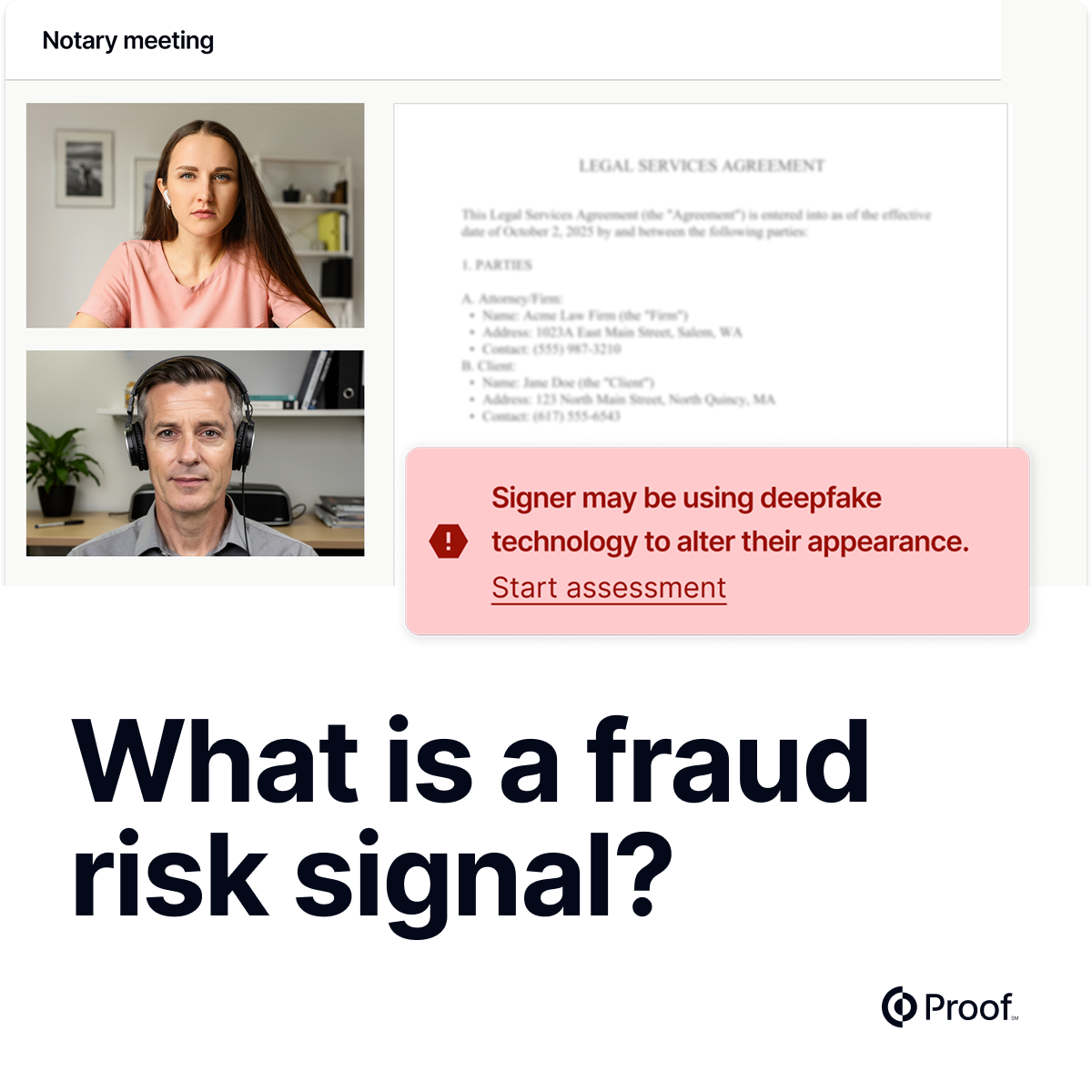
- Human-in-the-loop verification for high-stakes moments. Automated checks are appropriate for most interactions. For high-risk moments, including large wire authorizations, account changes, loan approvals, and document execution, live verification adds a layer that cannot be spoofed. Proof Verify connects customers to a live agent over encrypted video, with deepfake detection and recorded sessions that serve as evidence if a dispute arises.
- Behavioral monitoring across the transaction lifecycle. First-party fraud often does not reveal itself at onboarding. It emerges over time, through patterns of dispute behavior, unusual transaction sequences, or sudden changes in account activity. Proof Defend monitors interactions across channels, surfaces risk signals, and flags suspicious patterns before losses accumulate.
- Consistent claim validation. Customer support teams need tools to evaluate dispute claims against the actual record of what a customer did. With better data, they can distinguish between honest mistakes and deliberate fraud. Organizations that invest in this capability reduce both false positives (wrongly denying legitimate customers) and false negatives (approving fraudulent claims).
- Customer education. Some organizations go further by educating customers on what qualifies as fraud and the consequences of abusing consumer protections. This reduces the perception that first-party fraud is risk-free, particularly for opportunistic fraudsters who are not part of organized rings.
The evidence gap: why detection is not enough
Most fraud prevention tools are built to detect risk. They score transactions, flag anomalies, and route suspicious activity for review. That is necessary. It is not sufficient.
When a customer denies authorizing a transaction, signing a document, or approving an account change, the organization needs evidence, not just a risk score. A cryptographically secured, identity-bound record of the authorization is the only thing that holds up in a dispute, an arbitration, or a regulatory review.
This is the gap that most first-party fraud discussions do not address. Detection tells you something looks wrong. Evidence tells you exactly what happened, who authorized it, and when. Organizations that invest in creating defensible records at every critical interaction are building a defense that survives the dispute process, not just the transaction.
Building a stronger defense without punishing honest customers
The challenge is calibration. Controls strong enough to deter abuse must be light enough that honest customers remain unaffected.
The most effective approach is risk-based layering. Low-risk interactions get a fast, frictionless experience. High-risk interactions, defined by transaction size, account history, behavioral signals, or dispute patterns, get additional verification. This keeps the experience smooth for the majority of customers while concentrating scrutiny where it matters.
Leaders across financial services, retail, gaming, and lending are recognizing that identity verification is no longer just a compliance requirement. It is the foundation for every trusted interaction and the primary tool for creating the records that make first-party fraud provable.































.jpg)











































.jpg)