Proof

How North Korea’s IT Worker Program Exposes the Need for Continuous Identity Verification

North Korea’s state-sponsored IT worker program exploits fabricated identities, AI deepfakes, and U.S.-based facilitators to infiltrate global companies across multiple sectors by bypassing traditional hiring checks, highlighting the urgent need for continuous, robust identity verification and revamped onboarding and access security processes.

New

Proof launches portable digital identity for banks

Introducing portable identity

Learn more

Notarize now Log in

North Korea's IT Worker Program: Why Onboarding and Access Security Must Evolve

Updated August 4, 2026

North Korea's IT worker program is no longer a fringe threat. It is a structured, state-sponsored operation that exploits the weakest link in enterprise security: the hiring process. Okta's analysis uncovered more than 130 identities tied to North Korean IT workers attempting thousands of job interviews with companies worldwide. The program has expanded far beyond big tech, reaching finance, healthcare, government, and outsourcing firms across more than 40 countries. The United Nations estimates these workers generate between $250 million and $600 million annually for the regime.

The threat does not rely on advanced malware. It relies on trust. Specifically, it exploits the gap between who organizations assume they hired and who actually has access to their systems. Closing that gap requires rethinking onboarding and access security from the ground up.

Key takeaways

  • North Korean IT workers use fabricated identities, AI-generated deepfakes, and U.S.-based facilitators to pass standard hiring checks and gain legitimate system access.
  • Traditional background checks and document-based verification cannot detect synthetic or stolen identities at the scale this program operates.
  • The threat does not end at onboarding. Once inside, operatives hold multiple simultaneous jobs, exfiltrate data, and in some cases extort former employers after departure.
  • Identity verification must be embedded at every stage of the hiring funnel: resume submission, interview, pre-Day One onboarding, and ongoing access to sensitive systems.
  • Continuous identity assurance, not point-in-time verification, is the only model that scales with this threat.

How the North Korea IT worker program actually works

The scheme is operationally sophisticated. DPRK operatives do not hack in. They apply in.

Each operative begins by constructing a false identity using stolen or synthetic documents: passports, driver's licenses, Social Security cards. AI tools generate convincing profile photos. Fabricated portfolio websites and fake company references pass basic background checks. Operatives apply for hundreds of remote IT roles simultaneously, often targeting software development, QA testing, database management, and project management positions.

During interviews, they use AI-generated deepfakes to impersonate their fraudulent identity in real time. Some employ U.S.-based facilitators to attend video calls on their behalf. Once hired, the facilitator receives the corporate laptop at a domestic address, installs remote access software (AnyDesk, TeamViewer, RustDesk, TinyPilot), and routes the operative's connection through VPNs to mask their actual location, typically China or Russia.

According to U.S. Department of Justice reports, individual operatives can earn up to $300,000 annually. The North Korean government retains up to 90% of those earnings. CrowdStrike tracks this activity under the designation "FAMOUS CHOLLIMA" and has documented operatives posing as insiders at more than 100 U.S. technology companies.

The tactics have evolved. Google's Threat Intelligence Group (GTIG) documented one individual operating 12 separate personas across the U.S. and Europe. The FBI confirmed in January 2025 that operatives are now exfiltrating proprietary data and code, then holding it hostage for ransom. Some have publicly released stolen code when victims refused to pay.

Why traditional defenses fail against this threat

Traditional security controls were built for external attackers. This threat starts as an approved hire.

Recruiters rely on paper credentials and visual checks. Background check vendors attest to completion without guaranteeing the identity behind the documents is real. Video interviews, once considered a reasonable proxy for in-person verification, are now a vector for deepfake impersonation. VPN logins, inconsistent time zones, and camera-off calls have been normalized by remote work culture, stripping away the behavioral signals that once flagged anomalies.

The failure is structural. Most organizations treat identity as a point-in-time event: verify once at onboarding, then grant indefinite trust. That model does not hold when the person who passed the background check is not the person logging into your systems.

Responsibility is also fragmented. HR owns the hiring process. IT owns access provisioning. Security owns threat monitoring. None of them has a complete view of whether the human behind the screen is who they claim to be. By the time anyone notices something is wrong, access has already been granted, and in many cases, data has already moved.

Building a defensible hiring and access security program

Defending against the North Korea IT worker program requires identity verification at every stage of the hiring funnel, not just at the point of offer.

  • ‍ Stage 1: Resume submission. Require government ID verification before a resume reaches a recruiter. This single filter screens out fabricated identities before any human time is invested. It also signals to legitimate candidates that the organization takes authenticity seriously. ‍
  • Stage 2: Interview. Verified identity should confirm that the person on camera is the same person who applied. This means pairing digital identity verification with liveness detection and biometric comparison, not relying on visual judgment from a hiring manager. Hiring managers cannot catch deepfakes. That is not a failure of skill; it is a failure of tooling. ‍
  • Stage 3: Pre-Day One onboarding. A human-in-the-loop check before credentials are issued ensures that no impostor receives system access. This is the last gate before access is granted. It should be treated accordingly. ‍
  • Stage 4: Ongoing access. Apply zero-trust principles to people, not just devices. Re-verify identity before any sensitive action such as: code pushes, fund transfers, administrative changes, or access to sensitive repositories. Continuous behavioral monitoring can detect anomalies that human reviewers miss, including sign-ins from unexpected locations, session durations that exceed human limits, and data movement patterns that fall outside normal job scope.

Organizations should also audit how access is provisioned and de-provisioned. Accounts that remain active after contractors leave are a persistent insider risk. Access decisions should be tied to verified identity, not just job titles or employment status.

Continuous identity for a continuous threat

The DPRK IT worker program is the clearest demonstration that the perimeter is no longer where risk begins or ends. Nation-state actors are applying for jobs. They are passing background checks. They are sitting inside enterprise systems right now, in organizations that believe they hired someone else.

The only defense that scales with this threat is identity assurance that does not stop at onboarding. When every action on a platform is linked to a proven human, impostors lose their advantage. Trust becomes measurable, not assumed.

Future-proofing means building systems that can adapt to deception. The DPRK IT worker campaign is the latest example of how trust can be weaponized. The organizations that close this gap are the ones that treat identity as a continuous signal, verified at submission, at interview, at onboarding, and at every high-risk action that follows.

If your organization hires remote workers or contractors and relies on document-based verification alone, the gap is already open. See how Proof Identify works to close it.

Disclaimer: Proof's products are designed solely for identity verification and fraud prevention. They are not to be used to evaluate a candidate's qualifications, character, or suitability for employment.


graphic of envelop on a square

Subscribe to our newsletter

Sign up

Related Articles

\ \ Real Estate\ \ The Seller Who Isn't in the Room: What Remote Closings Actually Fix in Title and Escrow\ \ The buyer was ready, the file was clean, the date was set. One person needed to sign in front of a notary, and that person was going to be somewhere in the middle of a sea for the next eight weeks. Without a remote option, a closing that is otherwise finished waits until he gets back. Every title company has a version of this seller.\ \ \ \ Kavya Qin\ \ September 25, 2026

\ \ Financial Services\ \ The Exception Desk: Wire Callbacks | September 2026\ \ The Exception Desk is a monthly look at one exception process banks still run by hand — what it is, how it actually gets handled today, and what it would take to make it digital. First up: the wire callback.\ \ \ \ Jay Bletzer\ \ September 24, 2026

\ \ Hiring & Onboarding\ \ Why Fake Candidates Stopped Standing Out in Your Pipeline\ \ AI agents flooded your funnel with real applicants, which is exactly what gives fabricated ones somewhere to hide. Here is where the check has to move to.\ \ \ \ Lauren Furey\ \ September 23, 2026

\ \ Product & News\ \ Proof and Superfluid: A Verified Human Behind Every Agent Transaction\ \ Today Proof announces a partnership with Superfluid Finance in their launch of Superfluid Wallet, a wallet that a person and their AI agents use together. Proof provides the human identity layer of the wallet through verifiable credentials for both individuals and businesses.\ \ \ \ Proof\ \ September 22, 2026

\ \ Fraud\ \ The Fraud Files: When the Verification Layer Became the Target | September 2026\ \ Three years ago, deepfake fraud accounted for 0.1% of global fraud attempts. Today that figure is 6.5%, a 65-fold rise driven by injection attacks up 40% year over year and $410 million in first-half losses alone. The verification layer is the target now.\ \ \ \ Ray Hayes\ \ September 21, 2026

\ \ Financial Services\ \ The Last Mile That…Wasn't: Notarization Challenges in Lending and Equipment Finance\ \ Lending got fast. Then the Power of Attorney needs a notary…and the deal sits. Let’s talk about what happens when lending and financing workflows go fully digital, including notarization.\ \ \ \ Adam Fekini\ \ September 18, 2026

\ \ Fraud\ \ Why The Right Fraud Tools Can Help Stop Seller Impersonation\ \ ALTA found seller impersonation attempts more than doubled in a year, even as title firms added detection tools.\ \ \ \ Proof\ \ September 16, 2026

\ \ Workflow\ \ Remote Online Notarization: The Last Analog Step in Digital Transformation\ \ Digital transformation isn’t complete until the experience is seamless for your customer. See how Proof helps bring remote online notarization (the last analog step) online for organizations across industries.\ \ \ \ Proof\ \ September 16, 2026

\ \ Product & News\ \ Proof Launches Portable Digital Identity for Banks as Federal Regulators Recognize Verifiable Credentials Under CIP Rules\ \ Days after FinCEN and federal banking agencies updated customer-identification guidance to expressly include verifiable digital credentials, Proof launches a reusable digital identity backed by IAL2 identity proofing and its WebTrust-audited certificate authority.\ \ \ \ Proof\ \ September 15, 2026

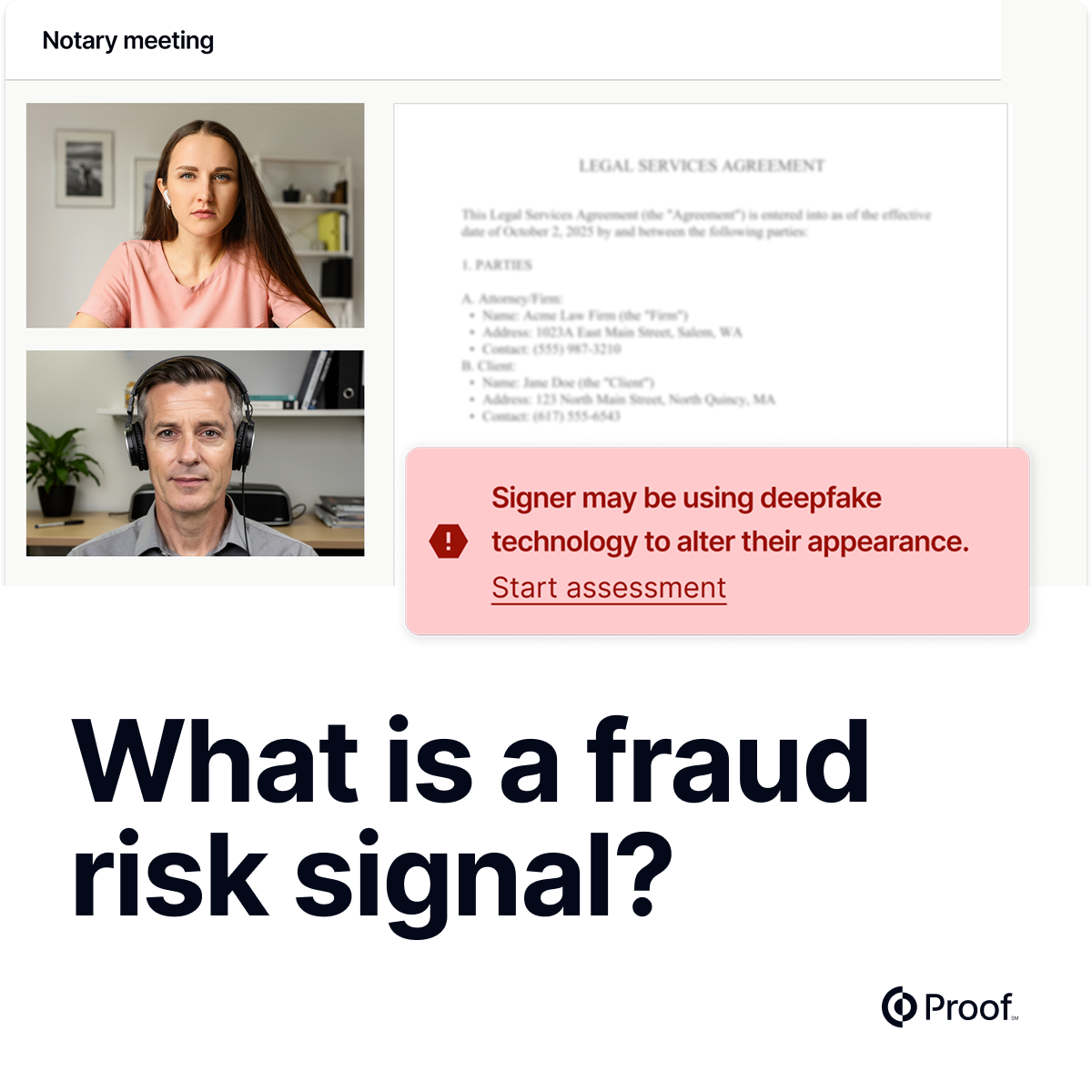
\ \ Fraud\ \ What is a Fraud Signal?\ \ A fraud signal is one piece of evidence about a transaction. Here is what the common signals measure and how they combine into a decision your team uses.\ \ \ \ Kurt Ernst\ \ September 14, 2026

\ \ Real Estate\ \ What Is MISMO Certification, and Why Do Mortgage Lenders Care Which RON Platform Has It?\ \ A lender closes a loan using one RON platform. Months later, that loan is sold to an investor whose due diligence team wants to confirm the notarization holds up to scrutiny. That's the exact problem MISMO's RON Certification exists to solve, and it's why "is this platform MISMO certified" is one of the first questions serious mortgage professionals ask before choosing a RON vendor. \ \ \ \ Jessica Howe\ \ September 10, 2026

\ \ Fraud\ \ The Sellers Never Showed Up. The Houses Sold Anyway.\ \ Two San Diego homes sold by people who never owned them and never met a buyer. Inside seller impersonation fraud.\ \ \ \ Proof\ \ September 9, 2026

\ \ Technology\ \ Mobile Notary, Online Notary, or Traditional Notary: When Should You Use Which?\ \ Mobile, online, and traditional notaries each solve a real problem, just not the same one, and the wrong choice usually costs you either time or money you didn't need to spend. Here's how to tell which situation you're actually in.\ \ \ \ Proof\ \ September 8, 2026

\ \ Fraud\ \ The ID Check Worked. It Left 153 Million Copies Behind.\ \ A dark web service sold scans of 153 million driver's licenses. Verifying identity should not mean storing the document.\ \ \ \ Proof\ \ September 3, 2026

\ \ Financial Services\ \ Six Money-Out Moments Worth Auditing in Your Firm\ \ Withdrawals, beneficiary changes, spousal consent, wires, account recovery, POAs. Audit the identity evidence your firm holds at each money-out moment.\ \ \ \ Ray Hayes\ \ September 3, 2026

\ \ Hiring & Onboarding\ \ What Deepfake Detection Actually Analyzes in a Candidate Video\ \ The question HR leaders ask most often after seeing deepfake detection in action: "But how does it actually know?" Most vendors respond with an accuracy rate, and that matters. But a rate tells you how a model performed against known attacks. What happens when attack techniques evolve?\ \ \ \ Kurt Ernst\ \ September 2, 2026

\ \ Product & News\ \ See Your Fraud Data, Keep Your Transaction History, and Close with Confidence. What’s new in August.\ \ This August, we're shipping updates across fraud detection, closing workflows, and transaction management. Defend gains automatic blocking of known bad actors, a configurable risk routing engine, and on-demand portfolio visibility into fraud performance. \ \ \ \ Proof\ \ September 1, 2026

\ \ Financial Services\ \ How Equipment Finance Companies Close Loans Remotely\ \ How lenders replace manual POA notarization with remote online notarization, closing in days instead of weeks, plus the identity gap at equipment pickup.\ \ \ \ Adam Fekini\ \ September 1, 2026

\ \ Digital Identity\ \ Authentication Verifies What You Have, Not Who You Are\ \ Authentication confirms you have the right credential. Cryptographic identity confirms you are who you say you are. Learn why the gap between those two questions is where enterprise breaches happen, and what closes it.\ \ \ \ Kris Singh\ \ August 28, 2026

\ \ Digital Identity\ \ Sanctions screening is live. Your KYB record isn't.\ \ Banks screen payments in real time but trust business identity in retrospect. Why point-in-time KYB leaves a gap that fraud is built to use.\ \ \ \ Kris Singh\ \ August 27, 2026
\ \ Digital Identity\ \ What Actually Happens During a Video Identity Verification Session with Proof\ \ What happens in a live video identity session with Proof: when it triggers, what runs during the call, who supervises it, and what you hold afterward.\ \ \ \ Lauren Hintz\ \ August 26, 2026

\ \ Hiring & Onboarding\ \ How to Catch Candidate Fraud Without Changing Your Greenhouse Workflow\ \ Identity verification has a reputation for slowing hiring teams down. A link goes to the candidate, a review queue opens somewhere, and your recruiters are waiting on a third system before anyone can move forward. That is not how Proof works inside Greenhouse.\ \ \ \ Eric Nelson\ \ August 25, 2026
\ \ Fraud\ \ 72 Fake Sites, One Phone Call: Vishing Hits Private Equity\ \ Hackers called employees at some of the largest private equity firms. The MFA codes were typed into 72 spoofed sites.\ \ \ \ Proof\ \ August 24, 2026

\ \ Digital Identity\ \ The Messy Identity Verification Stack Behind Most Online Gaming Platforms\ \ Gaming platforms layer six identity verification methods, from KYC to liveness detection. Learn what each proves, and where the stack leaves value exposed.\ \ \ \ Jessica Howe\ \ August 24, 2026

\ \ Digital Identity\ \ Why Identity-Verified Signing Matters, and How to Evaluate It\ \ Real estate fraud losses jumped 58% to $275 million in 2025, and most e-signature software still can't tell you whether the person who clicked "sign" is who they claim to be.\ \ \ \ Proof\ \ August 21, 2026

\ \ Auto\ \ The Three Identity Checks in an Auto Deal, and Why the Last One Breaks\ \ An auto deal verifies identity three times: credit application, signing, and title work. Let’s look at what each check proves, and why the last one stalls funding.\ \ \ \ Jay Bletzer\ \ August 20, 2026

\ \ Fraud\ \ The Fraud Files: When Trust Became the Attack Surface | August 2026\ \ Three separate findings from the first week of August 2026 arrived at the same structural conclusion from different directions. Attackers are moving away from defeating security controls and toward inheriting the trust those controls extend, and the identity layer is where the convergence is most visible.\ \ \ \ Ray Hayes\ \ August 19, 2026

\ \ Technology\ \ Electronic Signatures and Digital Signatures: The Difference and Why It Matters\ \ "Digital signature standard" gets used to describe cryptography, US law, and EU law almost interchangeably, and only one of those things determines whether the signature underneath can actually be forged.\ \ \ \ Gary Weingarden\ \ August 18, 2026

\ \ Fraud\ \ 1,000 Companies in 3 Months: North Korea's Hiring Infiltration\ \ A WSJ investigation traced North Korean operatives into US jobs. The gap they exploited is hiring identity.\ \ \ \ Proof\ \ August 17, 2026

\ \ Real Estate\ \ How to Evaluate eClosing Platforms\ \ A platform's fastest closing time is meaningless if it can't legally close a loan in the state where your borrower lives, so evaluate eligibility and integration before you look at the interface.\ \ \ \ Kavya Qin\ \ August 14, 2026

\ \ Fraud\ \ Inside the Fake-ID Detection Stack\ \ Modern identity verification stops fake IDs with five layered checks that each catch a kind of fraud the others miss, from image capture to behavioral risk scoring.\ \ \ \ Jessica Howe\ \ August 13, 2026

\ \ Technology\ \ How to Evaluate an Online Notary\ \ Legal authorization to perform remote online notarization is now nearly universal, so the real question isn't whether a platform is legal, it's whether its identity checks, session record, and notary training can survive a dispute years later.\ \ \ \ Phil Motto\ \ August 12, 2026

\ \ Hiring & Onboarding\ \ The Attack That Breaks the Identity Check You Just Deployed\ \ A lot of hiring teams have spent the past year adding liveness detection to their identity verification process. What this improvement cannot stop, however, is a biometric injection attack.\ \ \ \ Lauren Furey\ \ August 11, 2026

\ \ Digital Identity\ \ The 3 Checks That Catch Most Fake IDs Online\ \ Three checks, run together, stop the vast majority of fake IDs before they turn into a fraudulent account, a bad loan, or a forged signature on a closing document.\ \ \ \ Courtney Leary\ \ August 10, 2026

\ \ Workflow\ \ Which Digital Signature Standard Is Actually Secure?\ \ Ask which digital signature standard is "secure" and most people answer with a law: ESIGN, eIDAS, UETA. The layer that actually decides whether a signature can be forged is cryptographic, and it's called public key infrastructure, or PKI.\ \ \ \ Lauren Hintz\ \ August 7, 2026

\ \ Digital Identity\ \ The One E-Signature Feature That Actually Verifies Identity\ \ Real estate fraud losses hit $275 million in 2025, up 58% in a single year, and the feature that separates a defensible e-signature from a liability is whether the platform actually verifies who is signing.\ \ \ \ Anna Scionti\ \ August 6, 2026

\ \ Real Estate\ \ Is There a Best eClosing Platform? Here's the Short Answer\ \ The best eClosing platform is whichever one is legally eligible everywhere you close and already wired into the systems you run, with demo polish mattering only after both of those checks pass.\ \ \ \ Emily Robbins\ \ August 5, 2026

\ \ Technology\ \ What Makes a Good Online Notary? 3 Things That Actually Matter\ \ Remote online notarization is now legally authorized in nearly every state, but the law only sets a floor. Here are the three things that decide whether a notarization actually holds up.\ \ \ \ Jessica Howe\ \ August 4, 2026

\ \ Product & News\ \ More Ways to Verify, Authorize, and Protect. July Is Here.\ \ This July, we're shipping updates that expand Proof's identity verification capabilities across more workflows and platforms. New features include verifiable credential presentations via API, a drop-in SDK for web, and Okta IDV certification, giving organizations more ways to verify identity where it matters most.\ \ \ \ Proof\ \ July 29, 2026

\ \ Fraud\ \ Fake IDs, Fake Deeds, and $1.5M in Stolen Land\ \ Fraudsters forged deeds and fake IDs to steal a Concord landowner's property. Here's how verifiable identity stops it.\ \ \ \ Proof\ \ July 28, 2026

\ \ Digital Identity\ \ Who's Really Behind That Business? Why KYB Alone Can't Stop Invoice Fraud\ \ we sat down with Enigma last week to dig into a question that sounds almost philosophical until you've lost money to it: who is really behind that business?\ \ \ \ Abbie Kaiser\ \ July 27, 2026

\ \ Digital Identity\ \ Your Account Recovery Process Is Your Biggest Security Gap\ \ Stop relying on help desk judgment for account recovery. Learn how identity-first verification closes your biggest security gap and prevents vishing attacks.\ \ \ \ Kris Singh\ \ July 24, 2026

\ \ Technology\ \ The Authorization Gap: Why Agentic Commerce Can't Scale Without an Identity Layer\ \ Every major agentic commerce protocol has built serious infrastructure for how authorization records should flow. What none of them has defined is who issues the credentials that make those records trustworthy. We partnered with Liminal to research why this gap exists, why it can't close on its own, and what filling it actually requires.\ \ \ \ Jessica Howe\ \ July 23, 2026

\ \ Hiring & Onboarding\ \ What Identity Verification Actually Looks Like for Your Real Candidates\ \ Every conversation about candidate fraud eventually runs into the same concern: we can't add friction for candidates. The hiring market is competitive. Candidates drop off. A bad experience reflects on the employer brand, and the last thing a talent team needs is another step in the funnel that loses real people before they ever get to an interview.\ \ \ \ Leandra Fishman\ \ July 22, 2026

\ \ Financial Services\ \ The Real Cost of a Manual POA Process at Your Credit Union\ \ Power of attorney documents show up at some of the most consequential moments in a member's life. And yet, for most credit unions, the POA process is still built around paper. If that friction is costing you member trust, it is also costing you something else: time, money, and competitive ground.\ \ \ \ Jessica Howe\ \ July 20, 2026

\ \ Legal\ \ A Historic Step Toward the American Dream\ \ On July 10th, the 21st Century ROAD to Housing Act became law, marking the most significant bipartisan housing reform in decades. ROAD stands for Renewing Opportunity in the American Dream, and that is what the law sets out to do: expand access to homeownership for more Americans.\ \ \ \ James Fulgenzi\ \ July 17, 2026

\ \ Hiring & Onboarding\ \ This Is What Candidate Fraud Looks Like From the Inside\ \ Do you know how candidate fraud scams actually get built? Last week, a member of Proof's team received an email that answers that question directly.\ \ \ \ Lauren Ding\ \ July 15, 2026

\ \ Fraud\ \ The Fraud Files: Agents, Impersonation, and the Identity Layer Nobody Built | July 2026\ \ AI agents are transacting on behalf of real people, on real payment rails, right now. The fraud ecosystem built around that fact is already operational, and this month's headlines show exactly how the attack surface is forming.\ \ \ \ Ray Hayes\ \ July 13, 2026

\ \ Digital Identity\ \ What Is Digital Identity? A Complete Guide\ \ Digital identity is a persistent, cryptographically secured credential that represents a verified person. Once established, it does not expire with a session or reset between transactions. It travels with the user across interactions, and it gets stronger and more useful with every use.\ \ \ \ Anna Scionti\ \ July 10, 2026

\ \ Hiring & Onboarding\ \ The Return to In-Person Interviews Is an Admission, Not a Strategy\ \ What companies bringing interviews back in person have concluded is that they cannot verify who is sitting on the other end of a video call with enough confidence to make the hire. However, the remote-first format alone wasn’t the issue. What was missing underneath it was an identity layer reliable enough to make remote interviews trustworthy.\ \ \ \ Lauren Furey\ \ July 8, 2026

\ \ Auto\ \ Why Auto Lenders Can't Afford to Keep Mailing POAs\ \ Every auto refinance starts the same way: the borrower agrees to the new terms, the deal is approved, and then someone has to get a power of attorney signed so the lender can handle the title transfer without the borrower standing at the DMV counter in person. The lenders who are fixing this are funding faster, cutting operational costs, and closing a fraud vulnerability that paper processes leave wide open.\ \ \ \ Emmy Leitzell\ \ July 6, 2026

\ \ Hiring & Onboarding\ \ When You Find One Fraudulent Hire, You Usually Find More\ \ If one bad actor is successfully hired, they can act as a reference for others, using their insider knowledge of the employer's hiring process to coach additional fraudulent candidates through. That changes the threat model significantly. A single fraudulent hire inside a large remote workforce represents a vulnerability that has already been exploited to map the organization's defenses, and that map is being shared.\ \ \ \ Trisha Sood\ \ July 1, 2026

\ \ Product & News\ \ The Identity Infrastructure for the Internet\ \ The internet needs an identity layer that cryptographically proves who you are, what you've done, and which agents are operating in your name. To solve these challenges, we're releasing x401, an open, issuer-neutral protocol for the identity and authorization challenges created by agents, along with Proof digital ID, the first live implementation on x401, to bring a verified human identity and authorization to every agent action.\ \ \ \ Pat Kinsel\ \ June 29, 2026

\ \ Digital Identity\ \ The Five Levels of Verified Identity For the Agent Economy\ \ AI agents are moving money, but who verifies them? Explore the 5 levels of identity infrastructure required to make the agent economy safe and scalable.\ \ \ \ Darren Louie\ \ June 26, 2026

\ \ Product & News\ \ Introducing x401: Bringing Proof of Identity to the Web\ \ HTTP got a payment status code in 1997. It never got an identity one. We're fixing that. And, with AI agents acting on our behalf now, it matters more than ever.\ \ \ \ Daniel Buchner\ \ June 25, 2026

\ \ Product & News\ \ Proof Launches x401, the Open Protocol for Verifying the Authority Behind AI Agents\ \ Developed by Proof with contributors across payments, identity and AI, x401 lets any online service request proof of who authorized an agent’s actions. Live demos and a CLI are available today.\ \ \ \ Proof\ \ June 25, 2026

\ \ Digital Identity\ \ Why You Can’t Get Pokémon Center Drops (Hint: It’s Not Just Site Issues)\ \ On June 10, 2026, Pokémon Center opened preorders for the Mega Evolution: Pitch Black expansion and, within minutes, the site was down. For retailers and publishers managing high-demand, limited-inventory drops, identity verification at the point of queue entry is the mechanism that makes the difference between a queue full of real customers and a queue full of software.\ \ \ \ Mark Loiselle\ \ June 24, 2026

\ \ Fraud\ \ The Fraud Files: Stolen Credentials, Fake Biometrics, and the Synthetic Identity Wave | June 2026\ \ The way financial institutions verify identity was built around three assumptions: that some information stays secret, that documents can be trusted, and that a face in a camera is a real face. June's research shows each of those assumptions under sustained, commercial-scale attack, with numbers to prove it.\ \ \ \ Ray Hayes\ \ June 23, 2026

\ \ Workflow\ \ Sherpas Healthcare Solutions Wins More Clients with Remote Online Notarization\ \ Sherpas Healthcare Solutions takes the complexity out of chart audit requests for healthcare providers. As demand for notarized affidavits on those records grew, the company ran into a hard limit: they had no way to offer notarization services, and they were losing business to vendors who could. Remote online notarization with Proof gave them a way to say yes.\ \ \ \ Taylor Curtiss\ \ June 18, 2026

\ \ Product & News\ \ Cleaner Data, Tighter Security, and More Admin Control This June\ \ This month's updates are built for Enterprise and Command Center teams that need tighter control over their data and security posture. From deactivating child organizations directly in Command Center to pulling audit events into your SIEM and exporting richer transaction data, June's release gives admins more visibility and more power without requiring a support ticket or a CSM.\ \ \ \ Proof\ \ June 18, 2026

\ \ Technology\ \ Electronic Signatures vs. Digital Signatures: What's the Difference?\ \ The terms get used interchangeably, but they describe fundamentally different things. For most casual use cases, the distinction doesn't matter much. For regulated industries, high-value contracts, or anything that might end up in litigation, it matters a lot.\ \ \ \ Anna Scionti\ \ June 17, 2026

\ \ Hiring & Onboarding\ \ How Generative AI Turned Candidate Fraud Into an Industry\ \ Generative AI has transformed hiring fraud from an individual crime into an industrialized operation, changing the economics so completely that the defenses built for the previous era no longer apply.\ \ \ \ Taylor Curtiss\ \ June 16, 2026

\ \ Workflow\ \ Why Equipment Finance Teams Can't Afford a Manual POA Process\ \ The equipment finance industry is on a growth trajectory. The companies that take POAs digital now are the ones that close deals faster, carry less documentation risk, and build the kind of customer experience that brings lessees back for their next transaction.\ \ \ \ Taylor Curtiss\ \ June 15, 2026

\ \ Digital Identity\ \ How to Implement Digital Identity Verification\ \ Digital identity verification has become a baseline requirement for any organization that onboards customers, processes transactions, or manages sensitive documents online. This guide breaks down the core components of a digital identity verification system, the methods available, and what a thoughtful implementation looks like in practice.\ \ \ \ Courtney Leary\ \ June 12, 2026

\ \ Workflow\ \ Is Remote Online Notarization Legal and Available in All States?\ \ Remote online notarization (RON) is legal in 49 states and the District of Columbia as of 2026. California is the only outlier, with its permanent RON statute set to take effect on January 1, 2030. If your business is thinking about digitizing notarization workflows: yes, RON is an option.\ \ \ \ Phil Motto\ \ June 11, 2026
\ \ Hiring & Onboarding\ \ Why Only 31% of CHROs Are Confident They Can Stop Hiring Fraud\ \ While Chief Human Resources Officers (CHROs) agree hiring fraud requires attention, many doubt their organizations are equipped to stop it. This gap highlights a critical issue: awareness has risen, but infrastructure has not. Fraud persists despite organizational recognition.\ \ \ \ Renée Hunter\ \ June 10, 2026

\ \ Fraud\ \ Real Estate Fraud Hit $275M in 2025. The Fix Isn't Better Agent Training.\ \ Real estate fraud hit $275M in 2025, up 58%. AI is making fake IDs fast enough to pass standard verification at closing.\ \ \ \ Proof\ \ June 8, 2026

\ \ Workflow\ \ Proof Puts Itself To The Test For Account Recovery\ \ IT teams live at the intersection of access and urgency. When an employee is locked out, the pressure is to get them back in fast, and the path of least resistance has always been a direct message. For Proof's IT team, the answer was...Proof.\ \ \ \ Felicia Carnell\ \ June 5, 2026

\ \ Hiring & Onboarding\ \ Your Interviewers Can't Catch Deepfakes. That's Not Their Fault.\ \ If you ask most hiring managers whether they could spot a fake candidate in an interview, a significant number will say yes. They will point to their experience, their instincts, their ability to read a candidate's comfort with their own claimed background. That confidence is understandable and, according to the data, largely misplaced.\ \ \ \ Ashley Bird\ \ June 4, 2026

\ \ Real Estate\ \ The Top States for eClosings in 2026\ \ Your market has already made its decision. Peers and competitors are closing digitally, at significant volume, and they are getting faster at it. And the pattern is consistent: once enabling infrastructure is in place and a few early movers commit, adoption accelerates quickly.\ \ \ \ Kavya Qin\ \ June 3, 2026

\ \ Workflow\ \ What is Remote Online Notarization?\ \ The traditional notarization process has a well-known rhythm: print the document, find a notary office, drive there, show your ID, wait for the stamp. The whole thing can take the better part of a morning, and if anything goes wrong (wrong document, wrong ID, wrong office), you start over.Remote online notarization was built to replace that. Same legal result, without the overhead.\ \ \ \ Jessica Howe\ \ June 3, 2026

\ \ Hiring & Onboarding\ \ How to Catch Candidate Fraud Without Changing Your Lever Workflow\ \ We often see hiring teams skip identity verification because the tools available for it sit outside of their ATS. Requiring identity verification for candidates forces teams to manage a separate system and add steps for which they don’t have bandwidth or expertise. Proof now closes that gap for teams that use Lever.\ \ \ \ Eric Nelson\ \ May 28, 2026

\ \ Product & News\ \ Proof and Enigma Partner to Launch a Verified Business Identity and Authorization Layer for U.S. Businesses\ \ Every business needs to claim its identity online. We built the infrastructure to do it.\ \ \ \ Pat Kinsel\ \ May 27, 2026

\ \ Fraud\ \ Salesforce Under Attack: What the ShinyHunters Breach Reveals About CRM Identity Risk\ \ ShinyHunters stole 600,000 Salesforce records from a 7-Eleven franchisee. Here's what the breach reveals about CRM identity risk.\ \ \ \ Proof\ \ May 27, 2026

\ \ Product & News\ \ A Better Way to Notarize, for Cohen & Fitch LLP and Every Client They Serve\ \ Cohen & Fitch LLP is a New York civil rights firm. Their clients are navigating some of the hardest moments of their lives, and the last thing they need is friction around paperwork. So the firm built a notarization process that gives every client a real choice: come in person, handle it themselves through a local notary, or complete everything remotely through Proof on their own time.\ \ \ \ Proof\ \ May 26, 2026

\ \ Product & News\ \ Verified Identities, New Closing Types, and Faster Document Prep. Here's What's New in May.\ \ May's updates are focused on giving you more confidence and control at every stage of the transaction process. From a new verified badge that surfaces IAL2 verification status directly on identity profiles, to new transaction types for Title agents, to bulk sidebar actions that cut down document prep time significantly, this release is built to make your team faster and your transactions more trustworthy.\ \ \ \ Proof\ \ May 26, 2026

\ \ Fraud\ \ The Fraud Files: Bank Insiders, BEC Billions, and the AI Threat to ACH Payments | May 2026\ \ This month's fraud headlines read less like news and more like a preview of what happens when corporate ACH originators reach June 22 still exposed. Five signals, one through-line: authorized payments that should not have moved.\ \ \ \ Ray Hayes\ \ May 22, 2026

\ \ Hiring & Onboarding\ \ The Interview Isn't Where Candidate Fraud Gets Caught\ \ There is a documented case of a job applicant using deepfake technology to conduct a convincing interview for 70 minutes before being caught. That case gets cited as evidence of how good the fakes have gotten. But the more interesting (and maybe more important) thing it reveals is what had already happened before the call started.\ \ \ \ Lauren Furey\ \ May 20, 2026

\ \ Hiring & Onboarding\ \ The Insider Threat Your Hiring Pipeline Was Never Built to Catch\ \ Insider threat programs have long been a fixture at companies with high value assets. The threat model that justified that investment assumed a relatively targeted attacker: a nation-state, a competitor, or a sophisticated actor with a specific reason to come after that specific organization. That threat model is changing.\ \ \ \ John Heasman\ \ May 18, 2026

\ \ Fraud\ \ The New Generation of Scattered Spider Is Turning Account Recovery Into a Seven-Figure Business\ \ In 2023, a threat group called Scattered Spider dismantled two of the largest casino operations in the world. The next generation is now running seven figure scams, and they are actively targeting organizations across financial services, retail, hospitality, legal, aviation, technology, and academia.\ \ \ \ Winnie Jin\ \ May 12, 2026

\ \ Fraud\ \ Real Names, Fake IDs, and a Bank Insider: The Massachusetts Fraud Ring That Beat Two Lines of Defense\ \ A guilty plea in federal court last week pulls back the curtain on a coordinated bank fraud ring that operated across three states for more than two years. The scheme had two distinct vulnerabilities that let it run undetected. Both of them are solvable.\ \ \ \ Jessica Howe\ \ May 8, 2026

\ \ Technology\ \ Agentic AI Needs Verifiable Records to Be Trusted\ \ Logs and explanations are not enough. If agentic AI is going to operate in real world workflows, it needs verifiable records.\ \ \ \ Lauren Hintz\ \ May 6, 2026

\ \ Product & News\ \ Proof Joins FIDO Alliance to Link AI Agent Actions to Verified Human Identity\ \ As the only platform that can verify identity to NIST IAL2 and cryptographically bind it to agent activity, Proof brings a critical perspective to the standards defining how AI acts on behalf of humans.\ \ \ \ Proof\ \ May 4, 2026

\ \ Fraud\ \ The Fraud Files: Fraud Rings, AI Scams, and the Signals to Watch | April 2026\ \ Fraud trends rarely change all at once. More often, the signals appear gradually across research reports, news stories, and the operational reality of how organizations process digital transactions. Here are five signals from the past month that fraud and risk teams should be paying attention to.\ \ \ \ Ray Hayes\ \ April 29, 2026

\ \ Fraud\ \ Wigs, Fake IDs, and $19.8 Million in Loans: What the NFL Impersonation Scam Means for Lenders\ \ A former college football player disguised himself as three NFL stars to secure nearly $20 million in loans. The lenders who approved them had no reliable way to know the difference.\ \ \ \ Jim Schaffer\ \ April 27, 2026

\ \ Product & News\ \ Built for How You Work | What's New at Proof in April\ \ April's features are focused on speed and efficiency. From pre-built transaction templates to copy/paste shortcuts, self-serve plan upgrades, and smarter risk signals in Defend, here's what's new.\ \ \ \ Proof\ \ April 21, 2026

\ \ Fraud\ \ The VINsanity Indictment and the Urgent Need for Banks to Adopt Real Identity Verification\ \ Auto loan fraud is a serious crime that drives up costs for every honest consumer. It threatens the stability of lending institutions and undermines the digital economy. The VINsanity case illustrates the urgent need for better security across the industry. \ \ \ \ Jessica Howe\ \ April 20, 2026

\ \ Digital Identity\ \ Why KYC Alone No Longer Stops Fraud (and What Comes Next)\ \ KYC verifies whether customer information matches trusted data sources at onboarding. It confirms that a name, date of birth, or identification number aligns with existing records to meet compliance requirements. Modern fraud does not try to break that model. It works within it.\ \ \ \ Anna Scionti\ \ April 13, 2026

\ \ Fraud\ \ The $17 Million Real Estate Fraud Case That Should Change How Title Agents Verify Identity\ \ The U.S. Department of Justice charged 11 people in a sophisticated conspiracy targeting elderly homeowners. By stealing identities, these criminals secured millions in hard money loans against properties they had absolutely zero claim to. \ \ \ \ Kavya Qin\ \ April 8, 2026

\ \ Digital Identity\ \ What the U.S. Can Learn from Sweden’s BankID\ \ Identity fraud is rising in the U.S. due to fragmented verification. Learn why Sweden’s BankID model works and how Proof provides the cryptographic identity layer needed for high-risk digital commerce.\ \ \ \ Lauren Hintz\ \ April 6, 2026

\ \ Fraud\ \ AI Is Industrializing "Pig Butchering." Can Dating Apps Still Prove Their Users Are Real?\ \ The San Francisco Standard recently detailed a chilling evolution in the world of digital connection. "Pig butchering" scams, once the domain of low-level scripts, are now being powered by sophisticated generative AI. While the public focus is often on the devastating financial losses of the victims, there is a quieter, equally dangerous crisis unfolding for the dating platforms where these scams begin.\ \ \ \ Jessica Howe\ \ April 1, 2026

\ \ Digital Identity\ \ 23 NYCRR Part 500 Is a Regulatory Shift from Authentication to Attribution\ \ NYDFS 23 NYCRR Part 500 signals a shift from authentication to identity attribution. Learn why financial institutions must now provide verifiable, digital evidence.\ \ \ \ John Heasman\ \ March 30, 2026

\ \ Technology\ \ Passwordless Security: Why the Future of Authentication Still Starts with Identity\ \ For security teams and product teams alike, the appeal is straightforward. Passwordless systems reduce the risk of credential theft while also making login faster and easier for legitimate users. But removing passwords does not eliminate identity risk. It simply changes where that risk appears.\ \ \ \ Lauren Furey\ \ March 25, 2026

\ \ Product & News\ \ Deepfake Detection, Persistent Identity, and More — What's New in March\ \ This month's updates bring stronger fraud protection, faster identity verification, and more control for enterprise teams. From real-time deepfake detection in notary meetings to one-click identity reuse and new org management tools, there's something here whether you're running closings, preparing documents, or managing a multi-branch operation. \ \ \ \ Proof\ \ March 23, 2026

\ \ Product & News\ \ Get Paid the Moment You Complete: Instant Payouts Are Now Available on Proof\ \ Notaries on the Proof platform can now receive earnings directly to their Visa debit card — often within minutes of completing a session.\ \ \ \ Lauren Furey\ \ March 19, 2026

\ \ Real Estate\ \ Proof surpasses $640 billion in real estate transactions\ \ Rapid growth in residential real estate transactions on the platform indicates the industry is accelerating digital transformation to prioritize fraud prevention.\ \ \ \ Proof\ \ March 17, 2026

\ \ Legal\ \ The President’s Executive Order Is a Win for Digital Closings\ \ On March 13, President Trump signed an Executive Order to expand access to mortgage credit and address the regulatory barriers that have made buying a home harder and more expensive than it needs to be. We commend the administration for this leadership.\ \ \ \ James Fulgenzi\ \ March 16, 2026

\ \ Fraud\ \ Account Recovery: The Security Risk Hiding in Help Desk Requests\ \ Multi-factor authentication, fully-integrated identity providers, and passwordless logins have made it harder for attackers to break into enterprise systems using brute force. But attackers rarely attack the strongest defensive points directly. Instead, they look for the easiest path to gain access...account recovery workflows.\ \ \ \ Jeff Spencer\ \ March 16, 2026

\ \ Fraud\ \ Hospice Scams: What They Are, How They Work, and What Legitimate Providers Must Do Now\ \ Hospice fraud is not new. But in Los Angeles, the scale has reached a level that federal investigators describe as unprecedented.\ \ \ \ Courtney Leary\ \ March 11, 2026

\ \ Product & News\ \ Proof and IDEMIA Public Security Partner to Deliver Privacy-Preserving Digital Identity Solutions for Trusted Interactions Across Physical and Digital Ecosystems\ \ Proof, the trusted platform for securing the digital economy with cryptographically secured identity, and IDEMIA Public Security, a global leading provider of secure digital identity and trusted biometric-based solutions, today announced a strategic partnership to enable a trusted, broadly usable, privacy-preserving identity experience through a verifiable digital credential (VDC) that spans physical, logical ,and digital domains.\ \ \ \ Proof\ \ March 3, 2026