Proof

How To Protect Against Ransomware Attacks

The article "How To Protect Against Ransomware Attacks," updated August 20, 2026, highlights the escalating threat of ransomware—where cybercriminals infiltrate networks via phishing or stolen credentials to encrypt and steal data for ransom, often using double extortion tactics—and emphasizes that protecting organizations from such attacks is critical as paying ransoms or relying solely on backups no longer guarantees data security or operational continuity.

New

Proof gives AI agents a way to prove what they're authorized to do

Introducing portable identity

Learn more

Notarize now Help Log in

How To Protect Your Business Against Ransomware Attacks

Updated August 20, 2026

Ransomware shuts businesses down. From school systems canceling exams to a 157-year-old Illinois college closing permanently to the Colonial Pipeline attack that triggered gas shortages across the eastern United States, the damage is real and escalating. Knowing how to protect against ransomware attacks is no longer optional for any organization that depends on its systems and data to operate.

In a ransomware attack, cybercriminals gain access to a targeted network or application, typically through phishing or stolen credentials, then encrypt the organization's data and hold it hostage until a ransom is paid. Modern ransomware has evolved beyond encryption alone. In what's known as double extortion, attackers steal data before encrypting it, then threaten to publicly release it if the ransom isn't paid. Paying up doesn't guarantee your data stays private, and backups alone no longer fully protect you.

The financial toll is substantial. According to Sophos' The State of Ransomware Report 2022:

  • 66% of organizations experienced a ransomware attack in 2021, a 37% increase over 2020
  • The average ransom payment rose to over $800,000, five times the amount demanded in 2020
  • The IBM Cost of a Data Breach Report found the average ransomware attack cost $4.62 million, exceeding the $4.24 million average cost of a standard data breach

Because the damages can be so significant, businesses need to proactively prevent attacks, limit damage if an attack occurs, and ensure fast recovery. Here are five proven ways to do that.

Key takeaways

  • Ransomware exploits identity first. Most attacks begin with stolen credentials or phishing, which means protecting access and verifying who is behind every request is your first line of defense.
  • Zero trust reduces both intrusion likelihood and blast radius. Least-privileged access and micro-segmentation limit what an attacker can reach, even with valid credentials.
  • Multifactor authentication (MFA) is necessary but not sufficient. SMS-based codes can be intercepted through SIM-swapping; biometric verification adds a layer that's materially harder to compromise.
  • Identity assurance is the through-line. Every control described here, from zero trust to phishing training, ultimately protects identity and access. Organizations that verify who is behind every transaction and authorization request close the gap that ransomware exploits.

What is ransomware and how does it work?

Ransomware is malicious software that encrypts files or locks systems to force a victim into paying for recovery. Modern ransomware attacks do more than lock data. Different attack variants combine encryption, data theft, and extortion to pressure victims from multiple directions simultaneously.

Attackers don't appear out of nowhere. There is typically a window where the attacker is lurking inside the environment, exploring systems, establishing persistence, abusing credentials, and preparing to move fast. That dwell time is the window where prevention and detection controls can stop the attack before the ransom note appears.

Understanding how ransomware gets in is the foundation for knowing how to prevent ransomware attacks.

How ransomware attacks get into your organization

Ransomware enters through a small number of well-documented vectors. Closing these entry points is the most direct form of ransomware attack prevention:

  • ‍ Phishing and email-based delivery remain the most common entry point. According to IBM's X-Force Threat Intelligence Report, 41% of attacks started with phishing. Attackers craft convincing emails that replicate corporate logos, spoof sender addresses, and create urgency to prompt a click or an attachment download. ‍
  • Stolen credentials are the second major vector. Attackers purchase credentials from data breaches on dark web markets, then use them to authenticate as legitimate users. Once inside, they move laterally and escalate privileges before deploying ransomware. ‍
  • Remote Desktop Protocol (RDP) abuse is a persistent threat. RDP is convenient for remote access and equally convenient for attackers. Exposed RDP ports, combined with weak or reused passwords, give attackers a direct path into organizational systems. ‍
  • Vishing and social engineering have expanded beyond email. Attackers now use phone calls, SMS (smishing), and social media messages to trick employees into handing over credentials or logging into fake sites. The FBI has issued official warnings about this technique. ‍
  • Unpatched vulnerabilities in operating systems and applications give attackers exploitable entry points that have already been publicly documented. Unpatched systems stay on attacker targeting lists for exactly this reason.

Five ways to protect against ransomware attacks

1. Use a zero trust approach

Traditionally, businesses focused on protecting their physical network perimeter. With the rise of remote work and cloud-based systems, that perimeter no longer reliably exists. Zero trust has become the modern standard. The Microsoft Zero Trust Adoption Report 2021 found that 76% of organizations surveyed were in the process of implementing zero trust.

Zero trust is a framework built on the assumption that no user or device is authorized by default. Every access request requires verification. Within that framework, two controls are especially effective against ransomware:

  • Least-privileged access: Users are granted only the access required for their specific role. When stolen credentials are used in an attack, the attacker's reach is limited to that user's narrow permissions rather than the full network.
  • Micro-segmentation: The network is divided into small, isolated segments. If ransomware is deployed, it's contained to a single segment rather than spreading across the entire organization.

Implementing zero trust reduces both the likelihood of successful intrusion and the blast radius when one does occur.

2. Enforce multifactor authentication

Many ransomware attacks begin with stolen credentials. Making those credentials harder to use is one of the most direct defenses available. Multifactor authentication (MFA) requires users to prove their identity in two or more ways before accessing a system, and it's a core element of any zero trust implementation.

A standard setup requires both a password and a one-time code sent to a registered phone. Even if an attacker has the password, they can't access the system without also controlling the device. For higher-security environments, stronger MFA methods are available.

Biometric verification, including fingerprint scans and facial recognition, adds a layer that's much harder to compromise than a code sent via SMS. SMS-based codes can be intercepted through SIM-swapping attacks. The right approach depends on your risk profile, but every layer of authentication makes unauthorized access materially harder.

MFA is necessary, but it has limits. Attackers increasingly use social engineering and AI-generated impersonation to bypass authentication controls entirely. Identity verification that confirms a real, verified person is behind each request adds assurance that MFA alone cannot provide.

3. Back up data regularly and test recovery

Regular backups give organizations a path to recovery that doesn't depend on paying a ransom. Sophos found that 73% of organizations used backups to restore data encrypted during a ransomware attack.

To be effective, backups need to be isolated. If your backup lives on the same server as your primary data, ransomware can corrupt both at once. Store backups off-site and disconnected from the main network. Test the full recovery process regularly, not just the backup itself. Discovering a flaw in your restoration process during an actual attack is a costly way to find out.

One important caveat: backups address data encryption, but they don't address data theft. In double extortion scenarios, attackers exfiltrate sensitive data before encrypting it. A clean restore gets your systems running again, but it doesn't prevent the attacker from releasing that data. Detection speed and identity-layer controls matter as much as recovery infrastructure.

4. Prevent phishing attacks with technology and training

Phishing is the most common entry point for ransomware, and it works because attackers have become skilled at making malicious emails look legitimate, including replicating corporate logos and spoofing sender addresses.

Common phishing tactics:

  • Emails impersonating trusted brands, vendors, or internal IT teams
  • Links to convincing-looking login pages designed to capture credentials
  • Attachments containing malware that executes on download
  • Fake invoice or payment notifications that prompt urgent action

What you can do:

  • Deploy email scanning technology that flags malicious links and attachments before they reach employee inboxes
  • Train employees to recognize phishing indicators: mismatched sender addresses, spelling errors, and pressure to act quickly
  • Establish a clear reporting process so staff know where to send suspicious emails
  • Define what to do if someone accidentally clicks a link, such as disconnecting the device from the network and contacting IT immediately

AI-generated phishing has raised the stakes. Attackers now produce convincing, personalized messages at scale. Employee training reduces risk, but verification is the safety net when training isn't enough.

5. Train employees to recognize vishing and social engineering

As employees have become more cautious about phishing emails, attackers have expanded to vishing: voice-based social engineering attacks where a caller tricks an employee into handing over credentials or logging into a fake site.

The Proofpoint State of the Phish report found that 69% of organizations faced vishing attacks in 2021, yet only 23% of organizations globally include vishing in their security training.

Vishing has also expanded beyond phone calls. Attackers now use SMS (smishing) and social media messages to run similar schemes, creating a false sense of personal familiarity that causes employees to lower their guard. The through-line across all of these methods is the same: attackers are trying to get someone inside your organization to hand over their credentials.

Training employees to recognize these tactics is the most direct defense. Cover all three vectors: phone calls, text messages, and direct social media contact. Make it clear that no legitimate internal system will ask for credentials through these channels, and give employees a safe way to verify requests before acting on them.

Why identity is the real target in every ransomware attack

Ransomware attacks succeed when attackers can move through your systems unchallenged. Every measure described above, from zero trust to MFA to phishing training, is fundamentally about protecting identity and controlling access.

The attack chain is consistent across ransomware incidents:

  1. 1.Attacker gains initial access through phishing, stolen credentials, or RDP abuse
  2. 2.Attacker authenticates as a legitimate user
  3. 3.Attacker moves laterally, escalating privileges
  4. 4.Attacker exfiltrates data and deploys ransomware

Steps two and three depend entirely on the attacker being able to impersonate a legitimate identity without detection. Organizations that can verify who is behind every transaction, every credential, and every authorization request close the gap that ransomware exploits.

This is where identity verification becomes a ransomware defense, not just a compliance requirement. When every high-stakes authorization, whether that's an account recovery request, a wire transfer, or a system configuration change, is tied to a verified identity, attackers lose the ability to impersonate their way through your organization.

Building a layered defense against ransomware

Protecting against ransomware requires layered prevention and recovery controls working together. No single tool or policy closes every gap.

The most effective ransomware defense combines:

  • Zero trust architecture with least-privileged access and micro-segmentation
  • Strong MFA, preferably biometric, across all remote access points
  • Isolated, tested, off-site backups with verified recovery procedures
  • Email scanning and phishing awareness training
  • Vishing and social engineering training covering phone, SMS, and social media
  • Behavioral monitoring that detects suspicious activity before encryption begins
  • Identity verification at high-stakes authorization points to confirm who is really behind each request
  • A tested incident response plan that defines isolation steps, communication protocols, and recovery procedures

The organizations that contain ransomware fastest are the ones that catch attacker behaviors early, before encryption, lateral movement, and extortion can do the real damage.

Proof's identity verification and fraud detection help organizations verify who is behind every transaction, every credential, and every authorization request, so that compromised identities don't become entry points. Whether you're protecting a closing workflow, a financial transaction, or sensitive internal systems, the principle is the same: identity assurance is your first line of defense.

See how Proof Identify works to learn how Proof supports your organization's security posture.

graphic of envelop on a square

Subscribe to our newsletter

Sign up

Related Articles

\ \ Product & News\ \ From Fraud Defense to Agentic Workflows: October Product Updates\ \ This month’s updates expand what Proof can do across fraud defense, identity, and enterprise operations. Defend gets a new layer of protection against repeat fraudsters, Proof Digital ID reaches more users and more platforms, and the Proof MCP brings verified identity to agentic AI workflows for the first time. Here's a closer look at what's new.\ \ \ \ Proof\ \ October 28, 2026

\ \ Fraud\ \ Anatomy of a Fraud Attempt: Five Tries, Each Deepfake Better Than the Last\ \ A $74,000 cash-out came back five times, from a different country each time, the deepfake improving on every attempt. The pattern was the detection.\ \ \ \ Proof\ \ October 26, 2026

\ \ Fraud\ \ Anatomy of a Fraud Attempt: The Signer Who Changed Computers Mid-Session\ \ A signer joined a $195,000 transaction on a laptop and finished on a different desktop with high-end graphics. How a deepfake attempt actually runs.\ \ \ \ Proof\ \ October 23, 2026

\ \ Financial Services\ \ The Exception Desk: Beneficiary Changes | October 2026\ \ Forged beneficiary changes go unnoticed for years. Discover why current workflows fail identity checks and how Proof secures the process against fraud.\ \ \ \ Jay Bletzer\ \ October 22, 2026

\ \ Product & News\ \ Agentic commerce is here. The proof of authority is missing.\ \ Simon Taylor of Brainfood brought together leaders from Visa Intelligent Commerce, Circle, TD Bank, and Proof to discuss how agent payments get authorized and trusted by banks at Money20/20.\ \ \ \ Proof\ \ October 21, 2026

\ \ Product & News\ \ x401 Protocol Created by Proof Now Offers Simple Cloudflare Integration, So Cloudflare Workers Can Verify the Human Behind the Agent\ \ Built on HTTP’s familiar 401 and the OpenID for Verifiable Presentations standard, x401 is live in production and now works with Cloudflare Workers. \ \ \ \ Proof\ \ October 20, 2026

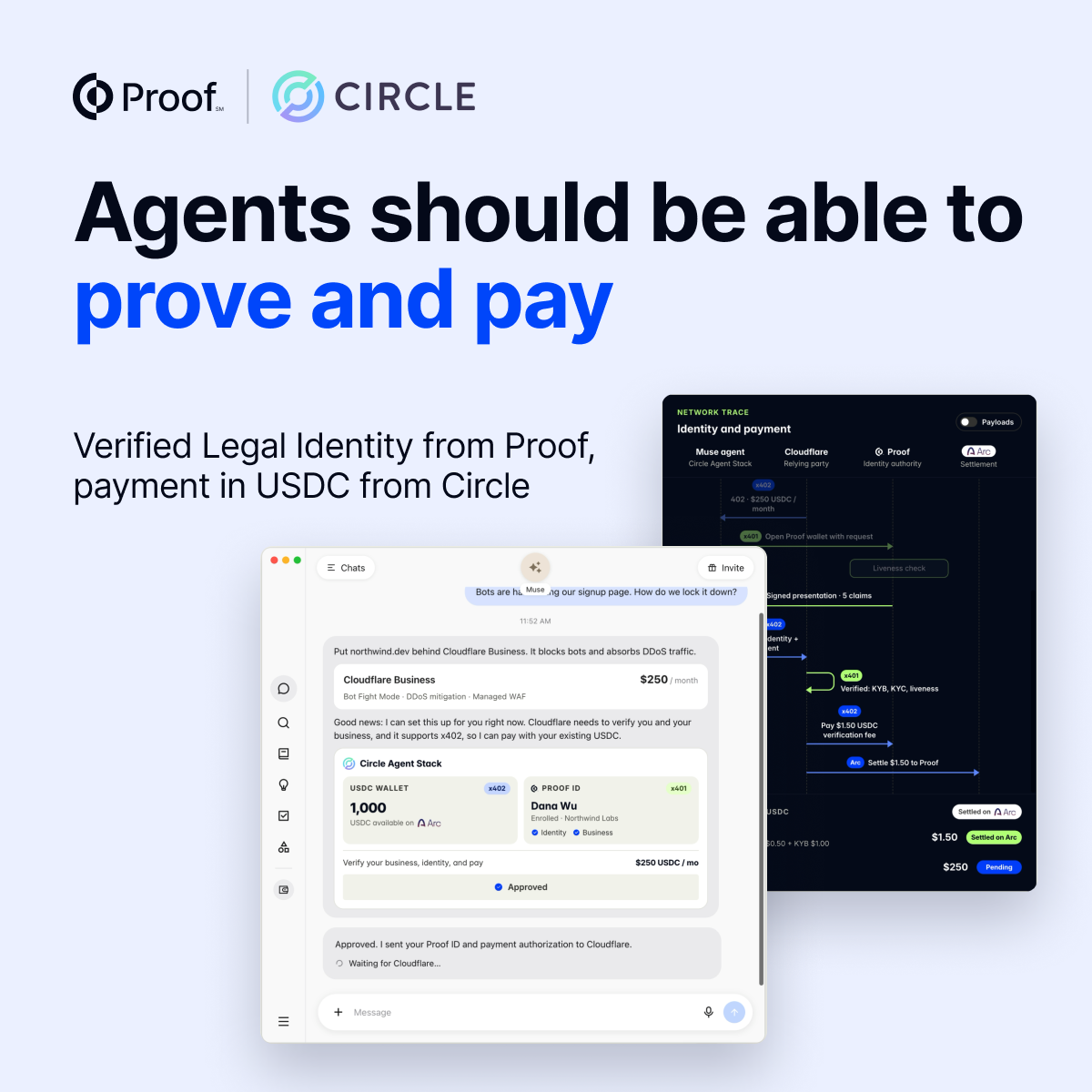
\ \ Product & News\ \ Proof and Circle Show How AI Agents Can Prove Who They Act For and Pay in USDC\ \ Proof and Circle Internet Group today announced a collaboration showing how verified legal identity and machine-native payments can work together in agent transactions. At Money20/20, teams from the companies will demonstrate a demo of an AI agent completing an identity-gated purchase where the agent presents a verified Proof credential using x401, Proof's open identity protocol, and pays the merchant in USDC over x402 using a Circle Agent Wallet.\ \ \ \ Proof\ \ October 19, 2026

\ \ Product & News\ \ Proof Launches x401, Giving AI Agents A Way to Prove Who They Represent - and What They're Authorized To Do\ \ Proof’s agent identity wallet and the open x401 protocol bring verified legal identity and signed transaction authorization to AI agents, with support for Meta’s Muse, ChatGPT, Grok and Claude, and pay-per-use verification\ \ \ \ Proof\ \ October 15, 2026

\ \ Fraud\ \ The Fraud Files: When Fraud Went Corporate | October 2026\ \ Agentic AI is expected to cut the cost of running a fraud operation by 90% within two years, according to BCG's June 2026 analysis, triggering a twofold surge in volume at minimum. In the same period, Fraud-as-a-Service platforms gave criminal networks subscription tiers, customer support channels, and the ability to rent SIM cards across 80 countries. Fraud got cheaper this month.\ \ \ \ Ray Hayes\ \ October 14, 2026

\ \ Fraud\ \ Anatomy of a Fraud Attempt: The Password Reset That Was the Attack\ \ No breach, no malware, no stolen password. The attacker used the account recovery flow exactly as designed. How the scheme runs and what stops it.\ \ \ \ Proof\ \ October 12, 2026

\ \ Fraud\ \ How Businesses Reduce Help Desk Social Engineering Attacks\ \ The help desk approves sensitive actions using evidence that was never strong enough to carry them. Replacing that evidence is the fix.\ \ \ \ Proof\ \ October 8, 2026

\ \ Hiring & Onboarding\ \ Candidate Fraud and the Continuity Gap in Remote Hiring\ \ Remote hiring kept every interview round and quietly dropped the handoff between them. We joined Recruiting Future Ep 825 to talk through what to do about it.\ \ \ \ Jessica Howe\ \ October 7, 2026

\ \ Product & News\ \ Proof Appoints Jeremiah Glodoveza as Chief Marketing Officer\ \ Award-winning payments and identity marketing leader joins to scale Proof's identity authorization network as AI agents reshape digital trust\ \ \ \ Proof\ \ October 6, 2026

\ \ Fraud\ \ An AI Just Passed the Video Turing Test. Who's on Your Next Call?\ \ Tavus says its AI fooled 48% of people on live video calls. Here's what that means for hiring and fraud teams.\ \ \ \ Proof\ \ October 5, 2026

\ \ Digital Identity\ \ What Makes ID Checks Fail\ \ Some failures turn away real people. The expensive ones return a clean pass on a transaction that should never have completed.\ \ \ \ Proof\ \ October 5, 2026

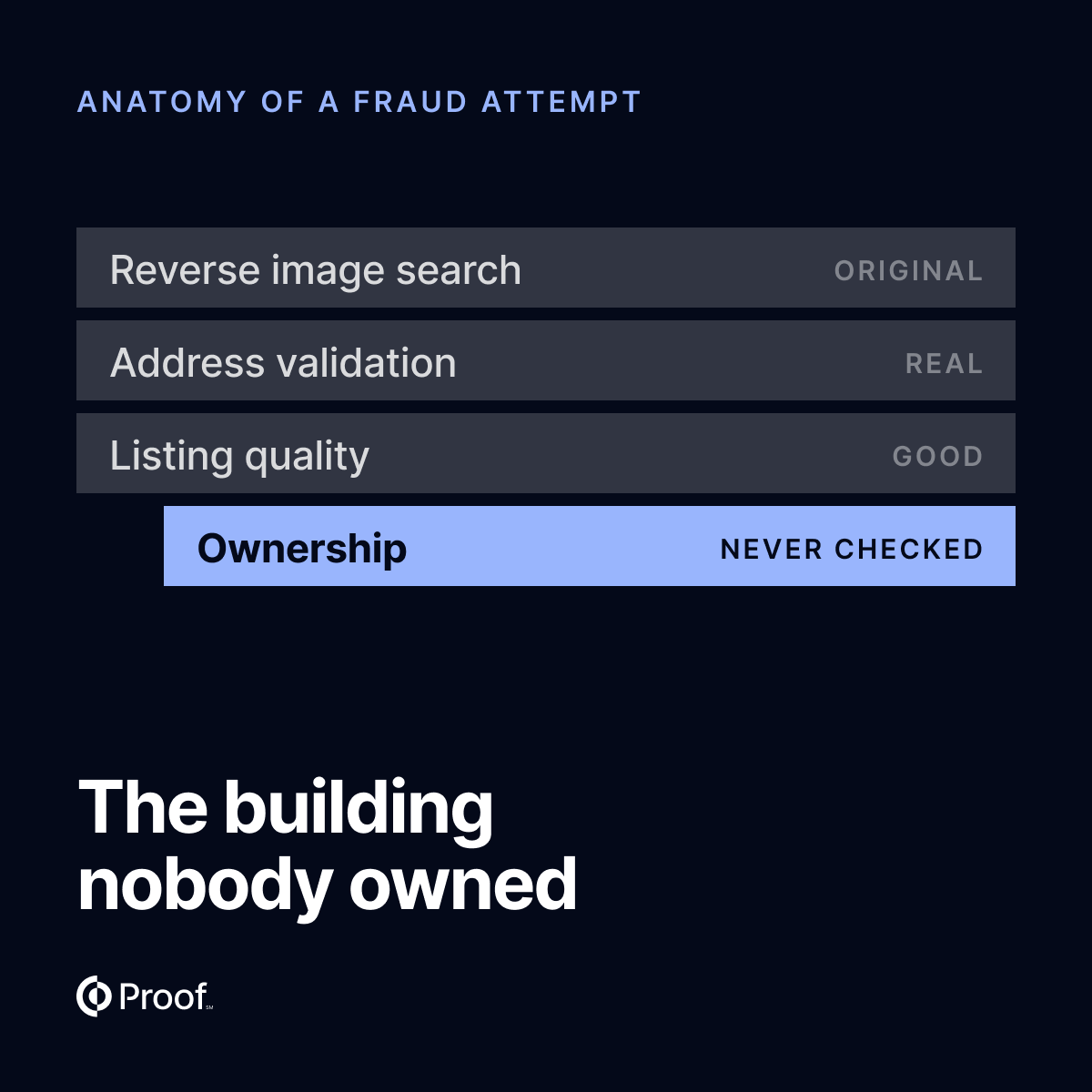
\ \ Fraud\ \ Anatomy of a Fraud Attempt: the Photograph of a Building Nobody Owned\ \ The building was real. The photos were real. The person renting it out owned none of it. How listing fraud runs, and the check that actually stops it.\ \ \ \ Proof\ \ October 4, 2026

\ \ Fraud\ \ Can AI Deepfakes Bypass Identity Verification?\ \ Yes. The working attacks replace the camera feed rather than fooling the camera, and most platforms stop watching before the transaction happens.\ \ \ \ Proof\ \ October 2, 2026

\ \ Fraud\ \ How Companies Prevent Account Takeover Fraud\ \ MFA closes the front door. Account recovery exists to open it again, and that is where the money goes.\ \ \ \ Proof\ \ October 1, 2026

\ \ Digital Identity\ \ How to Verify the Identity of an AI Agent\ \ An agent can complete the application perfectly and still get refused. What is missing is evidence that a verified person authorized it.\ \ \ \ Proof\ \ September 30, 2026

\ \ Hiring & Onboarding\ \ Face Rental: The Candidate Fraud That Passes Every Document Check\ \ A real person with a real government ID sits the interview while someone else does the work. Document checks, face match and liveness all pass. Here is what catches it.\ \ \ \ Kurt Ernst\ \ September 28, 2026

\ \ Real Estate\ \ The Seller Who Isn't in the Room: What Remote Closings Actually Fix in Title and Escrow\ \ The buyer was ready, the file was clean, the date was set. One person needed to sign in front of a notary, and that person was going to be somewhere in the middle of a sea for the next eight weeks. Without a remote option, a closing that is otherwise finished waits until he gets back. Every title company has a version of this seller.\ \ \ \ Kavya Qin\ \ September 25, 2026

\ \ Financial Services\ \ The Exception Desk: Wire Callbacks | September 2026\ \ The Exception Desk is a monthly look at one exception process banks still run by hand — what it is, how it actually gets handled today, and what it would take to make it digital. First up: the wire callback.\ \ \ \ Jay Bletzer\ \ September 24, 2026

\ \ Hiring & Onboarding\ \ Why Fake Candidates Stopped Standing Out in Your Pipeline\ \ AI agents flooded your funnel with real applicants, which is exactly what gives fabricated ones somewhere to hide. Here is where the check has to move to.\ \ \ \ Lauren Furey\ \ September 23, 2026

\ \ Product & News\ \ Proof and Superfluid: A Verified Human Behind Every Agent Transaction\ \ Today Proof announces a partnership with Superfluid Finance in their launch of Superfluid Wallet, a wallet that a person and their AI agents use together. Proof provides the human identity layer of the wallet through verifiable credentials for both individuals and businesses.\ \ \ \ Proof\ \ September 22, 2026

\ \ Fraud\ \ The Fraud Files: When the Verification Layer Became the Target | September 2026\ \ Three years ago, deepfake fraud accounted for 0.1% of global fraud attempts. Today that figure is 6.5%, a 65-fold rise driven by injection attacks up 40% year over year and $410 million in first-half losses alone. The verification layer is the target now.\ \ \ \ Ray Hayes\ \ September 21, 2026

\ \ Financial Services\ \ The Last Mile That…Wasn't: Notarization Challenges in Lending and Equipment Finance\ \ Lending got fast. Then the Power of Attorney needs a notary…and the deal sits. Let’s talk about what happens when lending and financing workflows go fully digital, including notarization.\ \ \ \ Adam Fekini\ \ September 18, 2026

\ \ Fraud\ \ Why The Right Fraud Tools Can Help Stop Seller Impersonation\ \ ALTA found seller impersonation attempts more than doubled in a year, even as title firms added detection tools.\ \ \ \ Proof\ \ September 16, 2026

\ \ Workflow\ \ Remote Online Notarization: The Last Analog Step in Digital Transformation\ \ Digital transformation isn’t complete until the experience is seamless for your customer. See how Proof helps bring remote online notarization (the last analog step) online for organizations across industries.\ \ \ \ Proof\ \ September 16, 2026

\ \ Product & News\ \ Proof Launches Portable Digital Identity for Banks as Federal Regulators Recognize Verifiable Credentials Under CIP Rules\ \ Days after FinCEN and federal banking agencies updated customer-identification guidance to expressly include verifiable digital credentials, Proof launches a reusable digital identity backed by IAL2 identity proofing and its WebTrust-audited certificate authority.\ \ \ \ Proof\ \ September 15, 2026

\ \ Fraud\ \ What is a Fraud Signal?\ \ A fraud signal is one piece of evidence about a transaction. Here is what the common signals measure and how they combine into a decision your team uses.\ \ \ \ Kurt Ernst\ \ September 14, 2026

\ \ Real Estate\ \ What Is MISMO Certification, and Why Do Mortgage Lenders Care Which RON Platform Has It?\ \ A lender closes a loan using one RON platform. Months later, that loan is sold to an investor whose due diligence team wants to confirm the notarization holds up to scrutiny. That's the exact problem MISMO's RON Certification exists to solve, and it's why "is this platform MISMO certified" is one of the first questions serious mortgage professionals ask before choosing a RON vendor. \ \ \ \ Jessica Howe\ \ September 10, 2026

\ \ Fraud\ \ The Sellers Never Showed Up. The Houses Sold Anyway.\ \ Two San Diego homes sold by people who never owned them and never met a buyer. Inside seller impersonation fraud.\ \ \ \ Proof\ \ September 9, 2026

\ \ Technology\ \ Mobile Notary, Online Notary, or Traditional Notary: When Should You Use Which?\ \ Mobile, online, and traditional notaries each solve a real problem, just not the same one, and the wrong choice usually costs you either time or money you didn't need to spend. Here's how to tell which situation you're actually in.\ \ \ \ Proof\ \ September 8, 2026

\ \ Fraud\ \ What Businesses Need to Know About ID Scans and Retention Risk\ \ A dark web service sold scans of 153 million driver's licenses. Verifying identity should not mean storing the document.\ \ \ \ Proof\ \ September 3, 2026

\ \ Financial Services\ \ Six Money-Out Moments Worth Auditing in Your Firm\ \ Withdrawals, beneficiary changes, spousal consent, wires, account recovery, POAs. Audit the identity evidence your firm holds at each money-out moment.\ \ \ \ Ray Hayes\ \ September 3, 2026

\ \ Hiring & Onboarding\ \ What Deepfake Detection Actually Analyzes in a Candidate Video\ \ The question HR leaders ask most often after seeing deepfake detection in action: "But how does it actually know?" Most vendors respond with an accuracy rate, and that matters. But a rate tells you how a model performed against known attacks. What happens when attack techniques evolve?\ \ \ \ Kurt Ernst\ \ September 2, 2026

\ \ Product & News\ \ See Your Fraud Data, Keep Your Transaction History, and Close with Confidence. What’s new in August.\ \ This August, we're shipping updates across fraud detection, closing workflows, and transaction management. Defend gains automatic blocking of known bad actors, a configurable risk routing engine, and on-demand portfolio visibility into fraud performance. \ \ \ \ Proof\ \ September 1, 2026

\ \ Financial Services\ \ How Equipment Finance Companies Close Loans Remotely\ \ How lenders replace manual POA notarization with remote online notarization, closing in days instead of weeks, plus the identity gap at equipment pickup.\ \ \ \ Adam Fekini\ \ September 1, 2026

\ \ Digital Identity\ \ Authentication Verifies What You Have, Not Who You Are\ \ Authentication confirms you have the right credential. Cryptographic identity confirms you are who you say you are. Learn why the gap between those two questions is where enterprise breaches happen, and what closes it.\ \ \ \ Kris Singh\ \ August 28, 2026

\ \ Digital Identity\ \ Sanctions screening is live. Your KYB record isn't.\ \ Banks screen payments in real time but trust business identity in retrospect. Why point-in-time KYB leaves a gap that fraud is built to use.\ \ \ \ Kris Singh\ \ August 27, 2026

\ \ Digital Identity\ \ What Actually Happens During a Video Identity Verification Session with Proof\ \ What happens in a live video identity session with Proof: when it triggers, what runs during the call, who supervises it, and what you hold afterward.\ \ \ \ Lauren Hintz\ \ August 26, 2026

\ \ Hiring & Onboarding\ \ How to Catch Candidate Fraud Without Changing Your Greenhouse Workflow\ \ Identity verification has a reputation for slowing hiring teams down. A link goes to the candidate, a review queue opens somewhere, and your recruiters are waiting on a third system before anyone can move forward. That is not how Proof works inside Greenhouse.\ \ \ \ Eric Nelson\ \ August 25, 2026

\ \ Fraud\ \ 72 Fake Sites, One Phone Call: Vishing Hits Private Equity\ \ Hackers called employees at some of the largest private equity firms. The MFA codes were typed into 72 spoofed sites.\ \ \ \ Proof\ \ August 24, 2026

\ \ Digital Identity\ \ The Messy Identity Verification Stack Behind Most Online Gaming Platforms\ \ Gaming platforms layer six identity verification methods, from KYC to liveness detection. Learn what each proves, and where the stack leaves value exposed.\ \ \ \ Jessica Howe\ \ August 24, 2026

\ \ Digital Identity\ \ Why Identity-Verified Signing Matters, and How to Evaluate It\ \ Real estate fraud losses jumped 58% to $275 million in 2025, and most e-signature software still can't tell you whether the person who clicked "sign" is who they claim to be.\ \ \ \ Proof\ \ August 21, 2026

\ \ Auto\ \ The Three Identity Checks in an Auto Deal, and Why the Last One Breaks\ \ An auto deal verifies identity three times: credit application, signing, and title work. Let’s look at what each check proves, and why the last one stalls funding.\ \ \ \ Jay Bletzer\ \ August 20, 2026

\ \ Fraud\ \ The Fraud Files: When Trust Became the Attack Surface | August 2026\ \ Three separate findings from the first week of August 2026 arrived at the same structural conclusion from different directions. Attackers are moving away from defeating security controls and toward inheriting the trust those controls extend, and the identity layer is where the convergence is most visible.\ \ \ \ Ray Hayes\ \ August 19, 2026

\ \ Technology\ \ Electronic Signatures and Digital Signatures: The Difference and Why It Matters\ \ "Digital signature standard" gets used to describe cryptography, US law, and EU law almost interchangeably, and only one of those things determines whether the signature underneath can actually be forged.\ \ \ \ Gary Weingarden\ \ August 18, 2026

\ \ Fraud\ \ 1,000 Companies in 3 Months: North Korea's Hiring Infiltration\ \ A WSJ investigation traced North Korean operatives into US jobs. The gap they exploited is hiring identity.\ \ \ \ Proof\ \ August 17, 2026

\ \ Real Estate\ \ How to Evaluate eClosing Platforms\ \ A platform's fastest closing time is meaningless if it can't legally close a loan in the state where your borrower lives, so evaluate eligibility and integration before you look at the interface.\ \ \ \ Kavya Qin\ \ August 14, 2026

\ \ Fraud\ \ Inside the Fake-ID Detection Stack\ \ Modern identity verification stops fake IDs with five layered checks that each catch a kind of fraud the others miss, from image capture to behavioral risk scoring.\ \ \ \ Jessica Howe\ \ August 13, 2026

\ \ Technology\ \ How to Evaluate an Online Notary\ \ Legal authorization to perform remote online notarization is now nearly universal, so the real question isn't whether a platform is legal, it's whether its identity checks, session record, and notary training can survive a dispute years later.\ \ \ \ Phil Motto\ \ August 12, 2026

\ \ Hiring & Onboarding\ \ The Attack That Breaks the Identity Check You Just Deployed\ \ A lot of hiring teams have spent the past year adding liveness detection to their identity verification process. What this improvement cannot stop, however, is a biometric injection attack.\ \ \ \ Lauren Furey\ \ August 11, 2026

\ \ Digital Identity\ \ The 3 Checks That Catch Most Fake IDs Online\ \ Three checks, run together, stop the vast majority of fake IDs before they turn into a fraudulent account, a bad loan, or a forged signature on a closing document.\ \ \ \ Courtney Leary\ \ August 10, 2026

\ \ Workflow\ \ Which Digital Signature Standard Is Actually Secure?\ \ Ask which digital signature standard is "secure" and most people answer with a law: ESIGN, eIDAS, UETA. The layer that actually decides whether a signature can be forged is cryptographic, and it's called public key infrastructure, or PKI.\ \ \ \ Lauren Hintz\ \ August 7, 2026

\ \ Digital Identity\ \ The One E-Signature Feature That Actually Verifies Identity\ \ Real estate fraud losses hit $275 million in 2025, up 58% in a single year, and the feature that separates a defensible e-signature from a liability is whether the platform actually verifies who is signing.\ \ \ \ Anna Scionti\ \ August 6, 2026

\ \ Real Estate\ \ Is There a Best eClosing Platform? Here's the Short Answer\ \ The best eClosing platform is whichever one is legally eligible everywhere you close and already wired into the systems you run, with demo polish mattering only after both of those checks pass.\ \ \ \ Emily Robbins\ \ August 5, 2026

\ \ Technology\ \ What Makes a Good Online Notary? 3 Things That Actually Matter\ \ Remote online notarization is now legally authorized in nearly every state, but the law only sets a floor. Here are the three things that decide whether a notarization actually holds up.\ \ \ \ Jessica Howe\ \ August 4, 2026

\ \ Product & News\ \ More Ways to Verify, Authorize, and Protect. July Is Here.\ \ This July, we're shipping updates that expand Proof's identity verification capabilities across more workflows and platforms. New features include verifiable credential presentations via API, a drop-in SDK for web, and Okta IDV certification, giving organizations more ways to verify identity where it matters most.\ \ \ \ Proof\ \ July 29, 2026

\ \ Fraud\ \ Fake IDs, Fake Deeds, and $1.5M in Stolen Land\ \ Fraudsters forged deeds and fake IDs to steal a Concord landowner's property. Here's how verifiable identity stops it.\ \ \ \ Proof\ \ July 28, 2026

\ \ Digital Identity\ \ Who's Really Behind That Business? Why KYB Alone Can't Stop Invoice Fraud\ \ we sat down with Enigma last week to dig into a question that sounds almost philosophical until you've lost money to it: who is really behind that business?\ \ \ \ Abbie Kaiser\ \ July 27, 2026

\ \ Digital Identity\ \ Your Account Recovery Process Is Your Biggest Security Gap\ \ Stop relying on help desk judgment for account recovery. Learn how identity-first verification closes your biggest security gap and prevents vishing attacks.\ \ \ \ Kris Singh\ \ July 24, 2026

\ \ Technology\ \ The Authorization Gap: Why Agentic Commerce Can't Scale Without an Identity Layer\ \ Every major agentic commerce protocol has built serious infrastructure for how authorization records should flow. What none of them has defined is who issues the credentials that make those records trustworthy. We partnered with Liminal to research why this gap exists, why it can't close on its own, and what filling it actually requires.\ \ \ \ Jessica Howe\ \ July 23, 2026

\ \ Hiring & Onboarding\ \ What Identity Verification Actually Looks Like for Your Real Candidates\ \ Every conversation about candidate fraud eventually runs into the same concern: we can't add friction for candidates. The hiring market is competitive. Candidates drop off. A bad experience reflects on the employer brand, and the last thing a talent team needs is another step in the funnel that loses real people before they ever get to an interview.\ \ \ \ Leandra Fishman\ \ July 22, 2026

\ \ Financial Services\ \ The Real Cost of a Manual POA Process at Your Credit Union\ \ Power of attorney documents show up at some of the most consequential moments in a member's life. And yet, for most credit unions, the POA process is still built around paper. If that friction is costing you member trust, it is also costing you something else: time, money, and competitive ground.\ \ \ \ Jessica Howe\ \ July 20, 2026

\ \ Legal\ \ A Historic Step Toward the American Dream\ \ On July 10th, the 21st Century ROAD to Housing Act became law, marking the most significant bipartisan housing reform in decades. ROAD stands for Renewing Opportunity in the American Dream, and that is what the law sets out to do: expand access to homeownership for more Americans.\ \ \ \ James Fulgenzi\ \ July 17, 2026

\ \ Hiring & Onboarding\ \ This Is What Candidate Fraud Looks Like From the Inside\ \ Do you know how candidate fraud scams actually get built? Last week, a member of Proof's team received an email that answers that question directly.\ \ \ \ Lauren Ding\ \ July 15, 2026

\ \ Fraud\ \ The Fraud Files: Agents, Impersonation, and the Identity Layer Nobody Built | July 2026\ \ AI agents are transacting on behalf of real people, on real payment rails, right now. The fraud ecosystem built around that fact is already operational, and this month's headlines show exactly how the attack surface is forming.\ \ \ \ Ray Hayes\ \ July 13, 2026

\ \ Digital Identity\ \ What Is Digital Identity? A Complete Guide\ \ Digital identity is a persistent, cryptographically secured credential that represents a verified person. Once established, it does not expire with a session or reset between transactions. It travels with the user across interactions, and it gets stronger and more useful with every use.\ \ \ \ Anna Scionti\ \ July 10, 2026

\ \ Hiring & Onboarding\ \ The Return to In-Person Interviews Is an Admission, Not a Strategy\ \ What companies bringing interviews back in person have concluded is that they cannot verify who is sitting on the other end of a video call with enough confidence to make the hire. However, the remote-first format alone wasn’t the issue. What was missing underneath it was an identity layer reliable enough to make remote interviews trustworthy.\ \ \ \ Lauren Furey\ \ July 8, 2026

\ \ Auto\ \ Why Auto Lenders Can't Afford to Keep Mailing POAs\ \ Every auto refinance starts the same way: the borrower agrees to the new terms, the deal is approved, and then someone has to get a power of attorney signed so the lender can handle the title transfer without the borrower standing at the DMV counter in person. The lenders who are fixing this are funding faster, cutting operational costs, and closing a fraud vulnerability that paper processes leave wide open.\ \ \ \ Emmy Leitzell\ \ July 6, 2026

\ \ Hiring & Onboarding\ \ When You Find One Fraudulent Hire, You Usually Find More\ \ If one bad actor is successfully hired, they can act as a reference for others, using their insider knowledge of the employer's hiring process to coach additional fraudulent candidates through. That changes the threat model significantly. A single fraudulent hire inside a large remote workforce represents a vulnerability that has already been exploited to map the organization's defenses, and that map is being shared.\ \ \ \ Trisha Sood\ \ July 1, 2026

\ \ Product & News\ \ The Identity Infrastructure for the Internet\ \ The internet needs an identity layer that cryptographically proves who you are, what you've done, and which agents are operating in your name. To solve these challenges, we're releasing x401, an open, issuer-neutral protocol for the identity and authorization challenges created by agents, along with Proof digital ID, the first live implementation on x401, to bring a verified human identity and authorization to every agent action.\ \ \ \ Pat Kinsel\ \ June 29, 2026

\ \ Digital Identity\ \ The Five Levels of Verified Identity For the Agent Economy\ \ AI agents are moving money, but who verifies them? Explore the 5 levels of identity infrastructure required to make the agent economy safe and scalable.\ \ \ \ Darren Louie\ \ June 26, 2026

\ \ Product & News\ \ Introducing x401: Bringing Proof of Identity to the Web\ \ HTTP got a payment status code in 1997. It never got an identity one. We're fixing that. And, with AI agents acting on our behalf now, it matters more than ever.\ \ \ \ Daniel Buchner\ \ June 25, 2026

\ \ Product & News\ \ Proof Launches x401, the Open Protocol for Verifying the Authority Behind AI Agents\ \ Developed by Proof with contributors across payments, identity and AI, x401 lets any online service request proof of who authorized an agent’s actions. Live demos and a CLI are available today.\ \ \ \ Proof\ \ June 25, 2026

\ \ Digital Identity\ \ Why You Can’t Get Pokémon Center Drops (Hint: It’s Not Just Site Issues)\ \ On June 10, 2026, Pokémon Center opened preorders for the Mega Evolution: Pitch Black expansion and, within minutes, the site was down. For retailers and publishers managing high-demand, limited-inventory drops, identity verification at the point of queue entry is the mechanism that makes the difference between a queue full of real customers and a queue full of software.\ \ \ \ Mark Loiselle\ \ June 24, 2026

\ \ Fraud\ \ The Fraud Files: Stolen Credentials, Fake Biometrics, and the Synthetic Identity Wave | June 2026\ \ The way financial institutions verify identity was built around three assumptions: that some information stays secret, that documents can be trusted, and that a face in a camera is a real face. June's research shows each of those assumptions under sustained, commercial-scale attack, with numbers to prove it.\ \ \ \ Ray Hayes\ \ June 23, 2026

\ \ Workflow\ \ Sherpas Healthcare Solutions Wins More Clients with Remote Online Notarization\ \ Sherpas Healthcare Solutions takes the complexity out of chart audit requests for healthcare providers. As demand for notarized affidavits on those records grew, the company ran into a hard limit: they had no way to offer notarization services, and they were losing business to vendors who could. Remote online notarization with Proof gave them a way to say yes.\ \ \ \ Taylor Curtiss\ \ June 18, 2026

\ \ Product & News\ \ Cleaner Data, Tighter Security, and More Admin Control This June\ \ This month's updates are built for Enterprise and Command Center teams that need tighter control over their data and security posture. From deactivating child organizations directly in Command Center to pulling audit events into your SIEM and exporting richer transaction data, June's release gives admins more visibility and more power without requiring a support ticket or a CSM.\ \ \ \ Proof\ \ June 18, 2026
\ \ Technology\ \ Electronic Signatures vs. Digital Signatures: What's the Difference?\ \ The terms get used interchangeably, but they describe fundamentally different things. For most casual use cases, the distinction doesn't matter much. For regulated industries, high-value contracts, or anything that might end up in litigation, it matters a lot.\ \ \ \ Anna Scionti\ \ June 17, 2026

\ \ Hiring & Onboarding\ \ How Generative AI Turned Candidate Fraud Into an Industry\ \ Generative AI has transformed hiring fraud from an individual crime into an industrialized operation, changing the economics so completely that the defenses built for the previous era no longer apply.\ \ \ \ Taylor Curtiss\ \ June 16, 2026

\ \ Workflow\ \ Why Equipment Finance Teams Can't Afford a Manual POA Process\ \ The equipment finance industry is on a growth trajectory. The companies that take POAs digital now are the ones that close deals faster, carry less documentation risk, and build the kind of customer experience that brings lessees back for their next transaction.\ \ \ \ Taylor Curtiss\ \ June 15, 2026

\ \ Digital Identity\ \ How to Implement Digital Identity Verification\ \ Digital identity verification has become a baseline requirement for any organization that onboards customers, processes transactions, or manages sensitive documents online. This guide breaks down the core components of a digital identity verification system, the methods available, and what a thoughtful implementation looks like in practice.\ \ \ \ Courtney Leary\ \ June 12, 2026
\ \ Workflow\ \ Is Remote Online Notarization Legal and Available in All States?\ \ Remote online notarization (RON) is legal in 49 states and the District of Columbia as of 2026. California is the only outlier, with its permanent RON statute set to take effect on January 1, 2030. If your business is thinking about digitizing notarization workflows: yes, RON is an option.\ \ \ \ Phil Motto\ \ June 11, 2026
\ \ Hiring & Onboarding\ \ Why Only 31% of CHROs Are Confident They Can Stop Hiring Fraud\ \ While Chief Human Resources Officers (CHROs) agree hiring fraud requires attention, many doubt their organizations are equipped to stop it. This gap highlights a critical issue: awareness has risen, but infrastructure has not. Fraud persists despite organizational recognition.\ \ \ \ Renée Hunter\ \ June 10, 2026

\ \ Fraud\ \ Real Estate Fraud Hit $275M in 2025. The Fix Isn't Better Agent Training.\ \ Real estate fraud hit $275M in 2025, up 58%. AI is making fake IDs fast enough to pass standard verification at closing.\ \ \ \ Proof\ \ June 8, 2026

\ \ Workflow\ \ Proof Puts Itself To The Test For Account Recovery\ \ IT teams live at the intersection of access and urgency. When an employee is locked out, the pressure is to get them back in fast, and the path of least resistance has always been a direct message. For Proof's IT team, the answer was...Proof.\ \ \ \ Felicia Carnell\ \ June 5, 2026
\ \ Hiring & Onboarding\ \ Your Interviewers Can't Catch Deepfakes. That's Not Their Fault.\ \ If you ask most hiring managers whether they could spot a fake candidate in an interview, a significant number will say yes. They will point to their experience, their instincts, their ability to read a candidate's comfort with their own claimed background. That confidence is understandable and, according to the data, largely misplaced.\ \ \ \ Ashley Bird\ \ June 4, 2026

\ \ Real Estate\ \ The Top States for eClosings in 2026\ \ Your market has already made its decision. Peers and competitors are closing digitally, at significant volume, and they are getting faster at it. And the pattern is consistent: once enabling infrastructure is in place and a few early movers commit, adoption accelerates quickly.\ \ \ \ Kavya Qin\ \ June 3, 2026

\ \ Workflow\ \ What is Remote Online Notarization?\ \ The traditional notarization process has a well-known rhythm: print the document, find a notary office, drive there, show your ID, wait for the stamp. The whole thing can take the better part of a morning, and if anything goes wrong (wrong document, wrong ID, wrong office), you start over.Remote online notarization was built to replace that. Same legal result, without the overhead.\ \ \ \ Jessica Howe\ \ June 3, 2026

\ \ Hiring & Onboarding\ \ How to Catch Candidate Fraud Without Changing Your Lever Workflow\ \ We often see hiring teams skip identity verification because the tools available for it sit outside of their ATS. Requiring identity verification for candidates forces teams to manage a separate system and add steps for which they don’t have bandwidth or expertise. Proof now closes that gap for teams that use Lever.\ \ \ \ Eric Nelson\ \ May 28, 2026

\ \ Product & News\ \ Proof and Enigma Partner to Launch a Verified Business Identity and Authorization Layer for U.S. Businesses\ \ Every business needs to claim its identity online. We built the infrastructure to do it.\ \ \ \ Pat Kinsel\ \ May 27, 2026

\ \ Fraud\ \ Salesforce Under Attack: What the ShinyHunters Breach Reveals About CRM Identity Risk\ \ ShinyHunters stole 600,000 Salesforce records from a 7-Eleven franchisee. Here's what the breach reveals about CRM identity risk.\ \ \ \ Proof\ \ May 27, 2026

\ \ Product & News\ \ A Better Way to Notarize, for Cohen & Fitch LLP and Every Client They Serve\ \ Cohen & Fitch LLP is a New York civil rights firm. Their clients are navigating some of the hardest moments of their lives, and the last thing they need is friction around paperwork. So the firm built a notarization process that gives every client a real choice: come in person, handle it themselves through a local notary, or complete everything remotely through Proof on their own time.\ \ \ \ Proof\ \ May 26, 2026

\ \ Product & News\ \ Verified Identities, New Closing Types, and Faster Document Prep. Here's What's New in May.\ \ May's updates are focused on giving you more confidence and control at every stage of the transaction process. From a new verified badge that surfaces IAL2 verification status directly on identity profiles, to new transaction types for Title agents, to bulk sidebar actions that cut down document prep time significantly, this release is built to make your team faster and your transactions more trustworthy.\ \ \ \ Proof\ \ May 26, 2026

\ \ Fraud\ \ The Fraud Files: Bank Insiders, BEC Billions, and the AI Threat to ACH Payments | May 2026\ \ This month's fraud headlines read less like news and more like a preview of what happens when corporate ACH originators reach June 22 still exposed. Five signals, one through-line: authorized payments that should not have moved.\ \ \ \ Ray Hayes\ \ May 22, 2026

\ \ Hiring & Onboarding\ \ The Interview Isn't Where Candidate Fraud Gets Caught\ \ There is a documented case of a job applicant using deepfake technology to conduct a convincing interview for 70 minutes before being caught. That case gets cited as evidence of how good the fakes have gotten. But the more interesting (and maybe more important) thing it reveals is what had already happened before the call started.\ \ \ \ Lauren Furey\ \ May 20, 2026

\ \ Hiring & Onboarding\ \ The Insider Threat Your Hiring Pipeline Was Never Built to Catch\ \ Insider threat programs have long been a fixture at companies with high value assets. The threat model that justified that investment assumed a relatively targeted attacker: a nation-state, a competitor, or a sophisticated actor with a specific reason to come after that specific organization. That threat model is changing.\ \ \ \ John Heasman\ \ May 18, 2026

\ \ Fraud\ \ The New Generation of Scattered Spider Is Turning Account Recovery Into a Seven-Figure Business\ \ In 2023, a threat group called Scattered Spider dismantled two of the largest casino operations in the world. The next generation is now running seven figure scams, and they are actively targeting organizations across financial services, retail, hospitality, legal, aviation, technology, and academia.\ \ \ \ Winnie Jin\ \ May 12, 2026